

2.28.26 – Preventing Midair Collisions – The ROTOR Act Should Have Passed

Saturday, February 28, 2026
Preventing Midair Collisions –
The ROTOR Act Should Have Passed
In response to the tragic yet preventable midair collision at DCA on January 29, 2025, APFA has been highly supportive of the National Transportation Safety Board’s (NTSB) safety recommendations, which includes mandating collision-avoidance technology on all aircraft operating in crowded airspace.
This week, the House of Representatives failed to reach a required two-thirds majority vote (264-133, 35 not voting) to pass the bipartisan ROTOR Act, despite unanimous Senate passage (100-0) in December.
APFA is incredibly disappointed that this major recommendation was not enacted into law this week. This misstep underscores the need for improved bipartisan and interagency collaboration. The failed vote is betrayal of the families who lost loved ones on Flight 5342 and PAT25, the crewmembers and aviation professionals who keep our airplanes safe every day, and the flying public who deserve regulations that adapt in the wake of tragedy.
The Rotorcraft Operations Transparency and Oversight Reform (ROTOR) Act would have modernized our airspace and strengthened safety for every passenger and crewmember by requiring precision location technology known as “ADS-B In” on all aircraft operating in congested airspaces, such as DCA. This anti-collision technology is imperative to increasing controllers and pilots’ situational awareness and avoiding midair collisions. Thank you, Chairman Cruz and Ranking Member Cantwell, for your efforts that successfully passed this bill in the U.S. Senate.
The ROTOR Act was endorsed by countless industry stakeholders including the families of the PSA 5342 passengers, air traffic controllers, pilots, flights attendants, air carriers, manufacturers, and U.S. DOT Secretary Sean Duffy. On February 12, NTSB Chair Jennifer Homendy testified before the Senate Commerce Committee about the NTSB’s final report and underscored that the fatal crash could have been prevented had the ROTOR Act been law at the time. “ADS-B In” technology was first formally recommended by the NTSB in 2008.
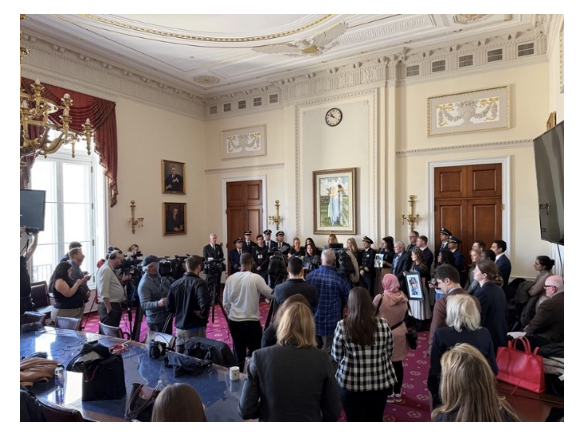
The ROTOR Act bill sponsors and the families of the victims of Flight 5342 speaking at a press conference on Capitol Hill (February 24, 2026).
Also in response to NTSB findings, APFA supports the FAA SMS Compliance Review Act of 2026, introduced by Ranking Members Cantwell and Duckworth, which directs the FAA to establish an independent expert review panel to make recommendations for a comprehensive, integrated, and effective FAA safety management system (SMS) to better predict, manage, and mitigate safety risks across the agency. The bill passed in the Senate on February 12.
On the House side, APFA is supportive of last week’s efforts to introduce the Airspace Location and Enhanced Risk Transparency (ALERT) Act of 2026. The comprehensive bill incorporates nearly all 50 safety recommendations issued by the NTSB. Increasing transparency and modernizing safety systems is essential to aviation safety, and we look forward to further collaboration of the bill’s drafted provisions to ensure that all the NTSB’s safety recommendations are codified as intended.
However, there is no reason the ROTOR Act should not have passed this week amidst continuing efforts to legislate additional NTSB recommendations. As currently written, the ALERT Act does not implement “ADS-B In” technology the way the ROTOR Act does.
APFA will continue to advocate that the NTSB’s safety recommendations become standard practice in our industry. We are working to build additional support for the ROTOR Act requirements in the House and exploring alternate paths to requiring “ADS-B In” collision-avoidance technology in our airspace.
Modernizing aviation safety standards should not require a tragic accident. Safety regulations need not be written in blood.
In Solidarity,
Allie Malis
Lori Vitto-Glattly
APFA Government Affairs Representatives
[email protected]

APFA Headquarters
1004 West Euless Boulevard
Euless, Texas 76040
M-F: 9:00AM - 5:00PM (CT)
Phone: (817) 540-0108
Contract & Scheduling Desk
M-Th: 9:00AM - 5:00PM (CT)
Phone: (817) 540-0108
Live Chat Messaging
Fridays: 9:00AM - 5:00PM (CT)
Currently, no scheduled events...