

Pay Types
Boarding Pay
APFA is the first Unionized Flight Attendant Group to ratify boarding pay in a collective bargaining agreement.
Boarding Pay
Flight Attendants are paid 50% of their rate of pay for scheduled boarding times and paid as pay no credit for Boarding Pay.
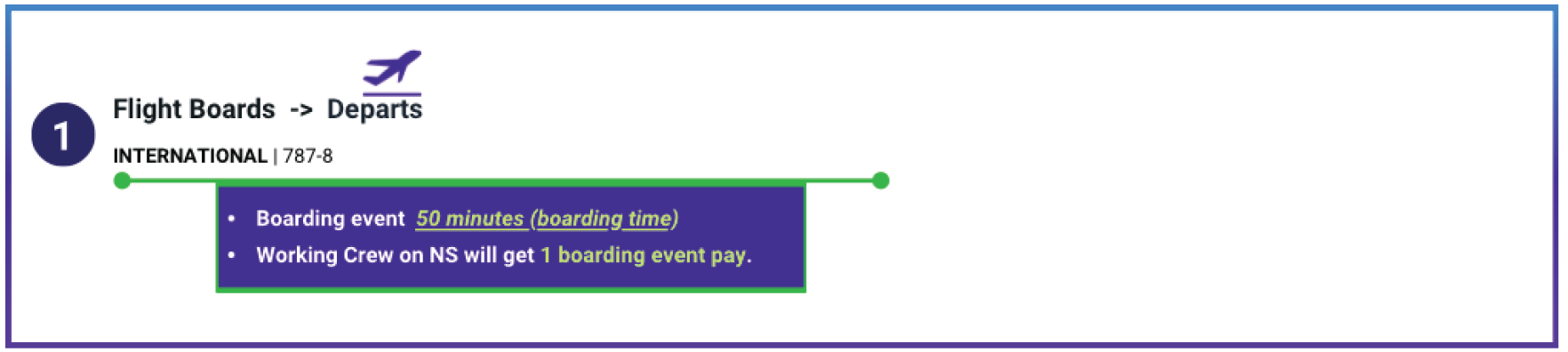
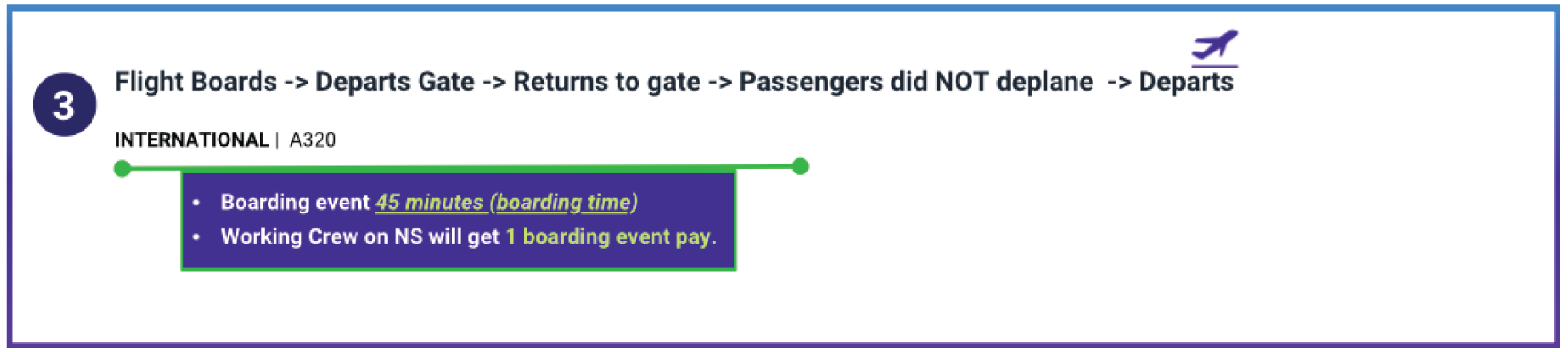
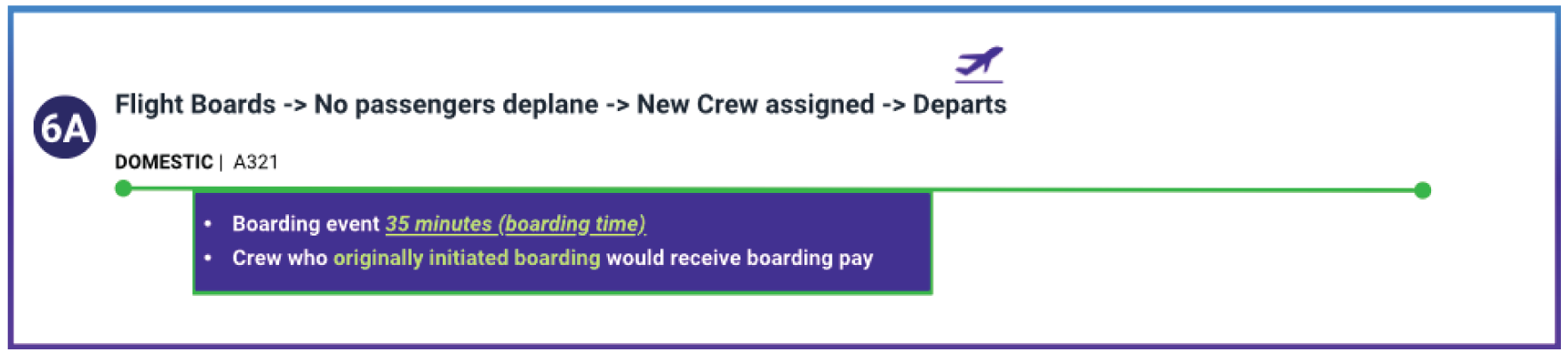
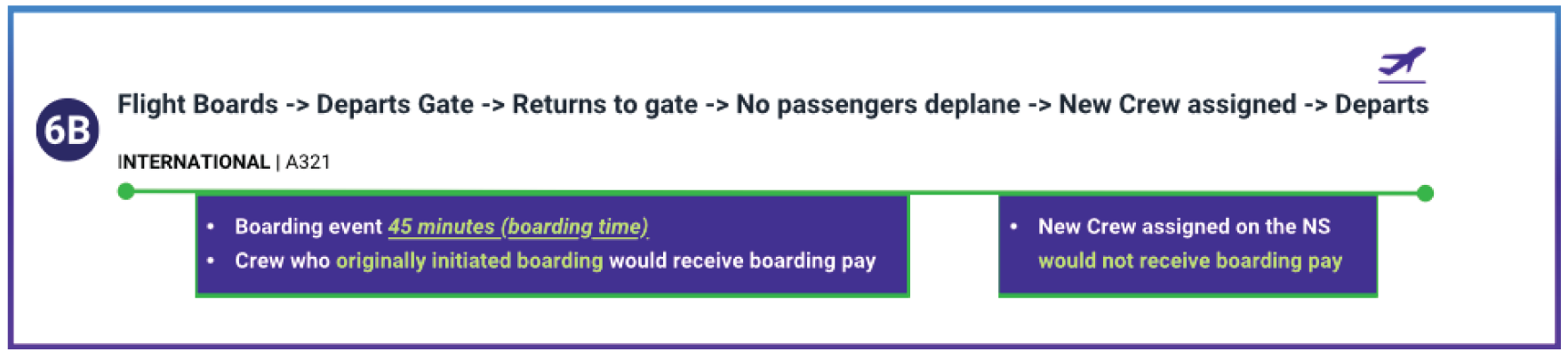
- Flight Attendants receive boarding pay for each segment actually boarded.
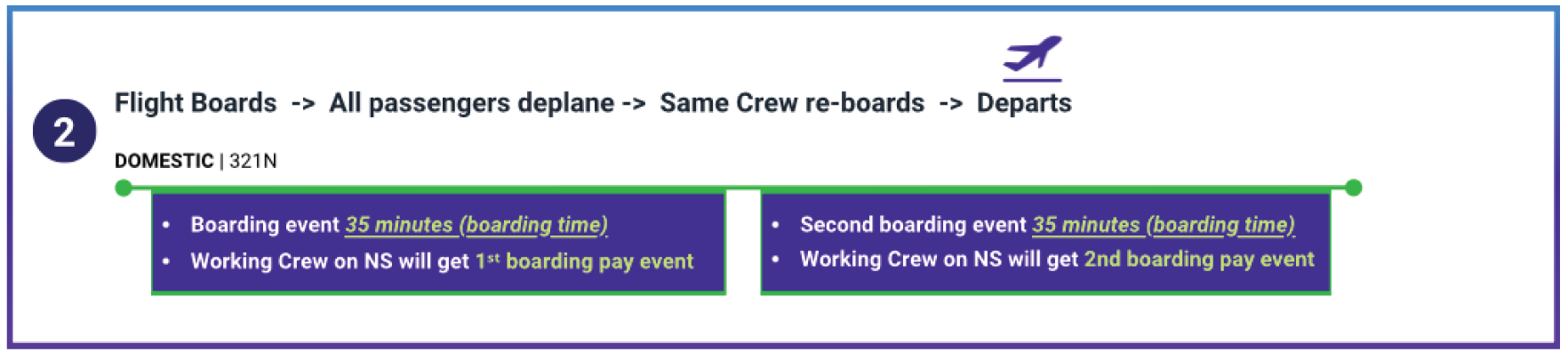
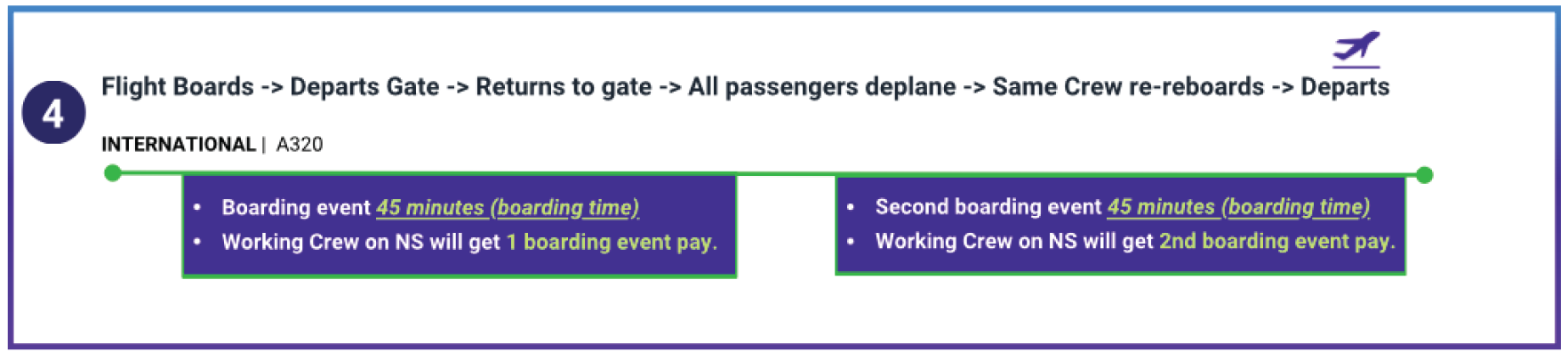
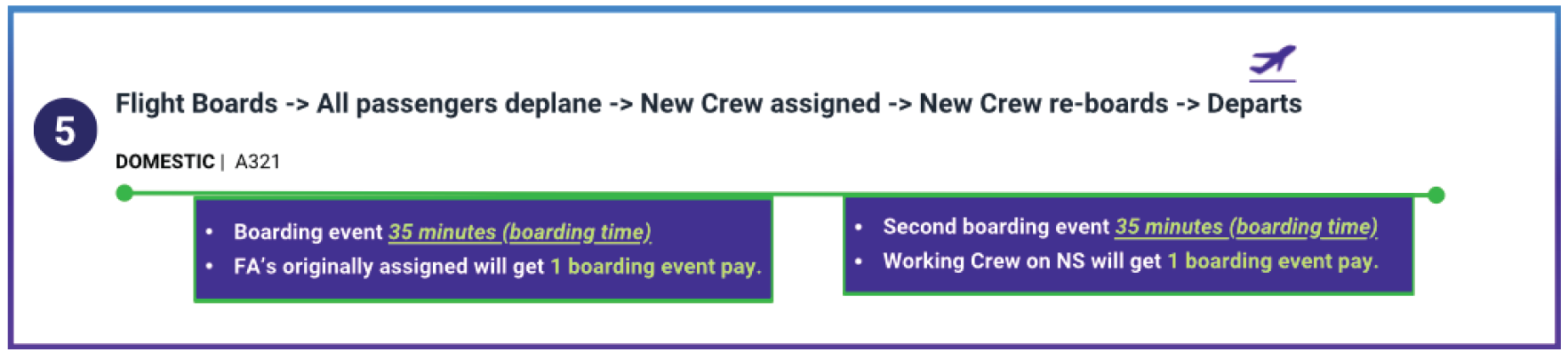
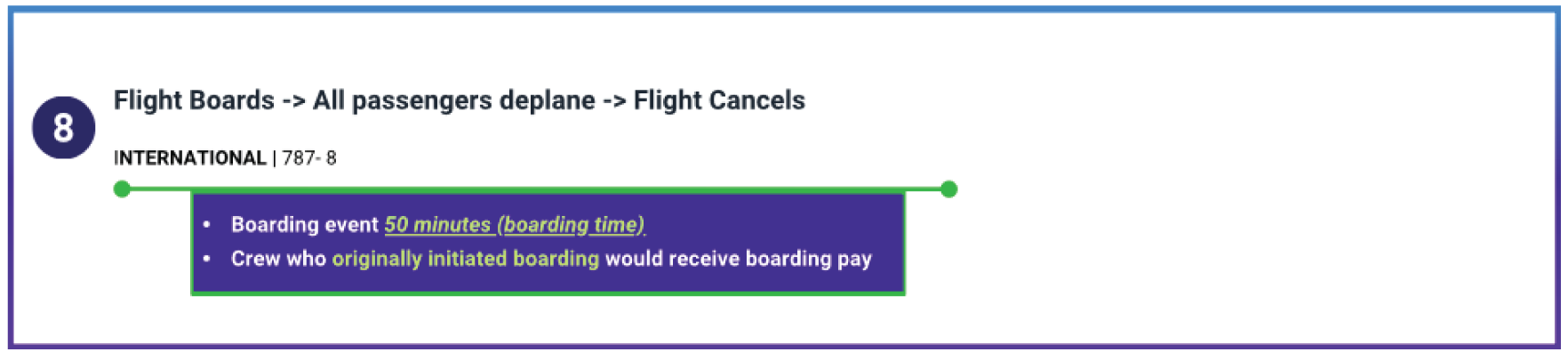
- If all passengers deplane, the Flight Attendant will receive boarding pay for each boarding event. (CBA Section 3.D)
* A flight Attendant will not receive boarding pay if they board a flight while on standby, unless actually working the segment
Boarding Pay is for scheduled boarding time only. Remember that boarding times are still contractual (CBA 11.M and 14.F) and boarding earlier than scheduled will not earn additional pay. Also, closing the door earlier than scheduled will not reduce any pay.
| 1 | $36.81 | $18.41 | $9.20 | $10.74 | $12.27 | $13.80 | $15.34 |
| 2 | $39.01 | $19.51 | $9.75 | $11.38 | $13.00 | $14.63 | $16.25 |
| 3 | $41.51 | $20.76 | $10.38 | $12.11 | $13.84 | $15.57 | $17.30 |
| 4 | $44.21 | $22.11 | $11.05 | $12.89 | $14.74 | $16.58 | $18.42 |
| 5 | $48.69 | $24.35 | $12.17 | $14.20 | $16.23 | $18.26 | $20.29 |
| 6 | $55.15 | $27.58 | $13.79 | $16.09 | $18.38 | $20.68 | $22.98 |
| 7 | $60.84 | $30.42 | $15.21 | $17.75 | $20.28 | $22.82 | $25.35 |
| 8 | $62.79 | $31.40 | $15.70 | $18.31 | $20.93 | $23.55 | $26.16 |
| 9 | $64.53 | $32.27 | $16.13 | $18.82 | $21.51 | $24.20 | $26.89 |
| 10 | $66.94 | $33.47 | $16.74 | $19.52 | $22.31 | $25.10 | $27.89 |
| 11 | $68.78 | $34.39 | $17.20 | $20.06 | $22.93 | $25.79 | $28.66 |
| 12 | $72.05 | $36.03 | $18.01 | $21.01 | $24.02 | $27.02 | $30.02 |
| 13+ | $84.50 | $42.25 | $21.13 | $24.65 | $28.17 | $31.69 | $35.21 |
Try our interactive calculator to get your boarding pay based on your Years of Service and total number of boardings:
Earning Boarding Pay
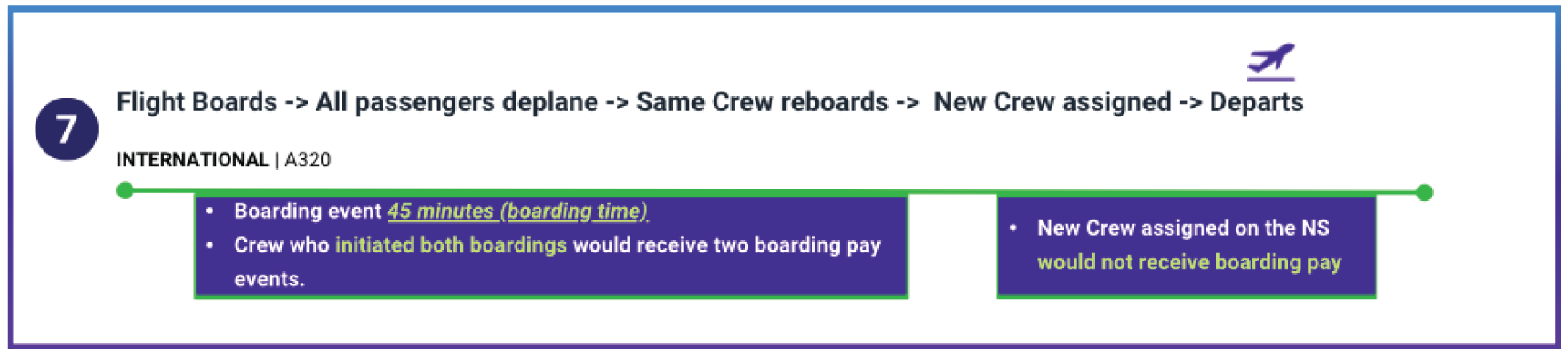
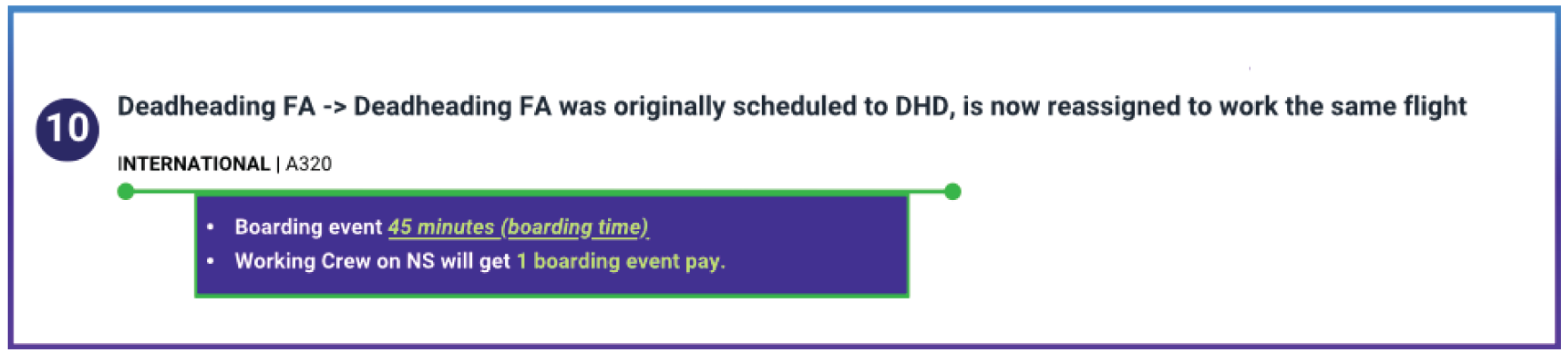
Boarding pay is eligible for each boarding event on a flight. If you board a flight, deplane, and board again, this would be two boarding pay events and eligible for two instances of boarding pay.
Initially, if you experience a partial boarding that then deplane, please file a Direct Connect to ensure this is captured and paid. While these instances should be captured by the automated program used by Crew Compensation, we want to make sure you are always paid in these scenarios regardless of how many passengers have boarded. As soon as a passenger steps onboard the aircraft, the crew is eligible for a boarding pay event.
Tracking Boarding Pay
Management will be deploying a tool to track boarding pay in the coming months. Until then, we encourage Flight Attendants to utilize the Boarding Calculator to track expected boarding pay and validate the amount on your paystub. If there are any discrepancies, please file a Direct Connect.
Boarding Pay Scenarios

Foreign Language Speaker Pay
A Speaker will be paid at two dollars ($2.00) per hour, prorated to the nearest minute, in addition to any other pay and applicable premiums, for all credit hours on any flight segment requiring her/his language skills. The Speaker premium will apply to all hours on deadhead flights.
International premium of three dollars ($3.00) or three dollars and seventy-five cents ($3.75) per hour, as applicable, in addition to the Speaker premium of two dollars ($2.00) per hour, shall apply to International segments for which the Flight Attendant’s language skills are required.
A Speaker, qualified in the language specified for the required Speaker positions on a flight segment, who is on the flight but not filling a required Speaker position, will be paid two dollars ($2.00) per hour, prorated to the nearest minute, in addition to any other pay and applicable premiums, for all credit hours on any segment matching her/his language skills.
Standby Pay
Standby is considered Pay and Credit as follows (CBA 12.F.9):
If you are on a standby and get assigned a sequence, you will be paid the value of your sequence and 1 hour for every 1 ¼ hours you were on standby (up to the report time of the sequence).
Example: Matilda is on 0600 standby. She gets called for a flight that departs at 0930. Matilda is paid standby pay up until the report time of the sequence (0830). Therefore, Matilda was on standby for 2 ½ hours so she will be paid 2 hours, plus the value for her sequence.
4 hour standby | 3:30
6 hour standby | 5:15
Red Flag Pay
At any time prior to departure, Crew Schedule may red flag a sequence/position in open time. Red flagged sequences shall be paid at the rate of one hundred and fifty percent (150%), and credited at one hundred percent (100%). Once a sequence is flagged it shall retain its premium for any pay protection provided within Section 10. If a Flight Attendant calls in sick for a red flagged sequence, no red flag premium will be applied.
Sequences which carry a red flag premium will be indicated as such in the Crew Management system. Flight Attendants may exclusively bid for red flagged sequences within TTS. The premium pay rate shall not be paid for any red flag sequence that is assigned to a Reserve on days of availability. A Reserve who picks up a red flagged sequence on her/his days off shall receive pay as referenced in Paragraph H.1. A Flight Attendant may exceed her/his monthly maximum to pick up a red flagged sequence.
Once a sequence has been red flagged, Crew Schedule may remove the red flag designation and its corresponding premium at any time prior to sequence award or assignment, up until 2300 HBT two days prior to the departure of the sequence. Once TOC Index 10-24 the TTS daily processing occurs on any day, the Company may not change the red flag designation until the TTS awards are complete for that day.
Red-flagged sequences are individual trips, flagged by Crew Scheduling that are paid at 150% and credited at 100% (Section 10.H). You’ll use TTS/UBL (Trip Trade System/Unsuccessful Bidders List) to bid for red-flagged sequences. They’ll be displayed in pink when viewed in Crew Portal. Once a trip is red flagged, the trip retains the 150% premium – even when pay protections come into play.
Example
You’re awarded a red-flagged trip through TTS/UBL and you become illegal through no fault (per Section 10.K) to work the trip. You’re pay protected at the 150% premium rate of pay.
Restrictions
Crew Scheduling can remove the red flag (and its premium) at any time before the sequence is awarded or assigned, up until 2100 HBT two days before departure.
- Once UBL daily processing starts, Crew Scheduling can’t change the red-flag designation until UBL awards are complete for that day.
- If you subsequently trade or drop the red-flagged sequence, the red flagged premium transfers with the trip.
- However, if you do a position swap involving a red-flagged sequence, the red-flagged premium stays with the original Flight Attendant.
- You can exceed your TTS max in order to pick up a red-flagged sequence; however, it will not increase your TTS max.
Reserves and Red-Flagged Sequences
If you are a reserve and pick up a red-flagged sequence on your day(s) off by using ROTA/ROTD, you’ll be paid the 150% premium. If you’re awarded/assigned the trip on a reserve day, the premium does not apply.
Vacation Pay
Flight Attendants with a block of seven (7) or more consecutive vacation days will be paid and credited at four (4) hours.
Flight Attendants with a block of fewer than seven (7) consecutive vacation days, they will be paid four (4) hours for each day but credited three and a half (3.5) hours per day.
When your vacation is shorter than a seven-day block, PBS and your HI1 will reflect three hours and thirty minutes (3.30) for each vacation day.
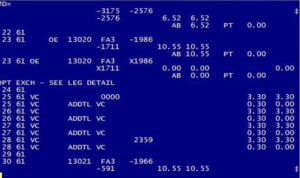
If you are on Reserve, this additional thirty (30) minutes per vacation day will be paid above guarantee. For a Lineholder, since the time is uncredited, it will not affect your TTS credit window or max. The additional 30 minutes of pay no credit for each of your vacation days will be added at close out for the month, usually around the 8th of the next month.
View more about bidding for Premium pay on vacation
Flight Attendants will receive each applicable Purser, Lead, Aft, Galley, Speaker, CRAF and International pay premium for vacation hours only if the credit hours in her/his primary line or PBS award, as applicable, are inclusive of one hundred percent (100%) of any single premium(s), e.g., 100% Speaker, 100% Lead, 100% Aft, etc.
Per Diem
A Flight Attendant shall be paid expenses for meals for each trip hour, prorated to the nearest minute, in accordance with the following rates:
| Effective Date | Domestic | International |
|---|---|---|
| Oct 1, 2024 | $2.85 | $3.40 |
| Oct 1, 2025 | $2.90 | $3.45 |
| Oct 1, 2026 | $2.95 | $3.50 |
| Oct 1, 2027 | $3.00 | $3.55 |
| Oct 1, 2028 | $3.05 | $3.60 |
International expenses shall apply to all trip segments to and from International destinations. Per Diem will not apply to Online Distance Learning.
Examples:
- A trip with a duty period that flies CLT-PHL-BDA: The CLT-PHL segment would pay the Domestic expenses rate and the PHL-BDA segment would pay International expenses.
- A trip that flies MIA-GIG-MIA: All segments would pay International expenses.
- A Flight Attendant assigned to training away from their crew base shall be paid expenses for meals at the above rates per hour for all hours away from their crew base including the check-in/check-out time for the deadhead to/from Recurrent training.
- A Flight Attendant awarded or assigned to training at their crew base, shall be paid Per Diem for all actual hours in training, excluding Online Distance Learning.
A Flight Attendant, when away from their crew base at places other than regular system layover stations, shall be paid reasonable actual expenses for meals or the above rates foreach trip hour, whichever is greater.
If a Flight Attendant is assigned a trip while on Reserve Standby, the Flight Attendant shall receive Per Diem from the commencement of Reserve Standby until the Flight Attendant is released in her/his crew base at the end of the assigned sequence.
Hotel Delays
Compensation for Hotel Delays Following Schedule Modification (RS, CX or other schedule change) (CBA 6.B.6)
— 150% pay for the duty period preceding the layover if the company fails to notify the Flight Attendant of their hotel assignment within one (1) hour of block in or within one (1) hour of the rescheduling timeline in CBA 10.J.3.d & 10.J.4.a, whichever is later.
— 150% pay for the entire sequence if the company fails to notify the Flight Attendant of their hotel assignment within three (3) hours of block in or within three (3) hours from the end of the rescheduling timeline in CBA 10.J.3.d & 10.J.4.a, whichever is later.
Jury Duty Pay
In accordance with CBA Section 3.H, Jury Duty is paid at a daily rate of 4:15 pay and credit.
The timing of when you submit your summons to the Company may have an impact on how many days you will be paid for jury duty. Please refer to the examples below to determine how you will be paid based on when you submit your summons and your jury duty obligation. It is recommended that you submit your summons as soon as you receive it by going to Comply 365 -> My Forms -> Inflight Admin Requests -> Jury Duty Leave Request.
Submitting your Summons Prior to PBS Awards
If you submit your Jury Duty summons to the Company before PBS awards are final (20th of the month at 1200 DFW Time) a planned absence will be added for each day that you are required to appear/call in for jury duty and the following day. You will receive a daily credit at the rate of four (4) hours and fifteen (15) minutes pay and credit per day. (CBA 3.H.1)
Jury Duty Summons submitted prior to when PBS awards are final (20th of the month at 1200 DFW Time). Summons is for the possibility to appear May 6-10 and instructs you to call in the day prior (May 5) and each subsequent day through May 9. You will receive Jury Duty pay and credit at the rate of 4:15 per day for May 5 through May 11.

Jury Duty Summons submitted prior to when PBS awards are final (20th of the month at 1200 DFW Time). Summons requires you to appear beginning May 6 through May 10. However, you are not required to call in the day prior. You will receive Jury Duty pay and credit at the rate of 4:15 per day, as required on the summons, beginning May 6 through May 10 and the following day (May 11).

Jury Duty Summons submitted prior to when PBS awards are final (20th of the month at 1200 DFW Time). Summons requires you to appear May 6-10 and instructs you to call in the day prior (May 5). You will receive Jury Duty pay and credit at the rate of 4:15 per day as required on the summons, beginning May 5 through May 10 and the following day (May 11).

If you are required to remain on call or are required to report for jury duty and you are on a Reserve day of availability or have a sequence conflict, you will be paid the daily credit for each day of the jury duty obligation. If you are released from jury duty after 1200, you shall be eligible for pay protection at the daily rate for the following day (assuming the sequence that was given up was operated on such date) but not thereafter. (CBA Section 3.H.3.)
Example
You are required to appear or were chosen for a jury pool extending your service after May 10. After May 10, you will receive Jury Duty pay and credit at the rate of 4:15 per day as required to appear for jury duty and had a sequence/reserve duty conflict. You will be paid and credited for the following day at the end of the jury/appearance if there was a reserve or sequence conflict on such day but not thereafter.
In this example, the last day you are required to appear for jury duty is May 16 after 12pm. You will be removed for sequences on May 12-13 and May 17-18.
Submitting your Summons After PBS Awards
If you jury duty summons is submitted to the Company after PBS awards are final and such jury duty assignment conflicts with a scheduled sequence, training day or reserve days, you will be paid at the daily rate for the day you must call in for jury duty, the days you are scheduled to appear for jury duty and the following day. (CBA 3.H.2.)

If you are required to remain on call or are required to report for jury duty and you are on a Reserve day of availability or have a sequence conflict, you will receive Jury Duty pay and credit at the rate of 4:15 per day for each day of the jury duty obligation. If you are required to report for jury duty, you shall be eligible for pay protection at the daily rate for the following day (assuming the sequence operated on such date) but not thereafter. (CBA 3.H.3.)


Full Month of Jury Duty
A Lineholder who is serving on jury duty for a full month will be paid to her/his applicable monthly maximum. A Reserve serving on jury duty for a full month will be paid on the basis of sequences missed as described above. In no case would such Reserve be paid and credited less than her/his applicable monthly guarantee, and in no case more than her/his applicable monthly maximum. (CBA 3.H.4.)
A Lineholder will bid in PBS as normally and will receive a PPO (Pay Purpose Only) award. If your PBS award is 90 hours or less, you will receive 90 hours of pay. If your PBS award is 90:01 hours or more, you will receive 110 hours of pay.
A Reserve serving on jury duty for a full month will be paid the reserve guarantee of 75 hours.
24 in 7 Legalities
If, through any combination of a Flight Attendant’s scheduled duty with the Company and jury duty, she/he is not provided with at least one (1) calendar day off in seven (7), such Flight Attendant shall have the right to move her/his scheduled day(s) off as necessary to provide the required minimum one (1) day off. (CBA 3.H.4.)


Training Pay
A Flight Attendant shall receive one hundred and fifty dollars ($150.00) pay for each day of Recurrent training. If Distance Learning is substituted for a day of Recurrent training, the Flight Attendant shall be paid one hundred and fifty dollars ($150.00) pay for the Distance Learning.
A Flight Attendant shall receive one hundred and fifty dollars ($150.00) pay for each day of non-Recurrent classroom training.
A Flight Attendant shall receive the following pay for non-Recurrent Distance Learning as determined by the amount of time a Flight Attendant would reasonably take to complete the training: up to two (2) hours twenty-five dollars ($25.00); two (2) hours and one (1) minute to four (4) hours fifty dollars ($50.00); four (4) hours and one (1) minute to eight (8) hours seventy-five dollars ($75.00).
A Flight Attendant who reports to the airport for her/his scheduled deadhead to training, including a scheduled deadhead from her/his residence as specified in Paragraph H.1, and the flight fails to operate or is delayed so that the Flight Attendant will not be able to attend training or arrive home within the sixteen (16) hour limitation will receive a minimum of three (3) hours pay and credit, provided an alternate deadhead flight and training class is not available within the sixteen (16) hour limitation, determined by the check-in time for the original flight.
Subsequent Recurrent Because of Failure
The provisions of CBA 29.E shall not apply when a Flight Attendant is required to attend a subsequent Recurrent program because of her/his failure to satisfactorily complete the initial Recurrent program. Paragraph E shall not be applicable to base indoctrination. (CBA 29.E.5)
Holiday Pay
Holiday pay will be paid to all Flight Attendants, both Reserves and Lineholders, working on a designated holiday, regardless of how you obtained the trip.
The holiday pay consists of a premium of 100% over your base hourly rate and is based on the greater of scheduled or actual hours flown (including reschedules) on a designated holiday. The holiday premium will be paid above guarantee for Reserves. The holiday premium will be pay no credit for Lineholders and will not raise or lower your TTS max.
Current Holidays
The following nine (9) days that are currently designated as holidays (CBA 3.K.1):
- Wednesday before Thanksgiving Day
- Thanksgiving Day
- Sunday following Thanksgiving
- Monday following Thanksgiving
- December 24th
- December 25th
- December 26th
- December 31st
- January 1st
Incentive Point and Holiday Pay 2026 – 2027
|
Incentive Point / Critical Period 2026-2027 |
Holiday Pay Days 2026-2027 |
|---|---|
| July 1 - July 7 | --- |
| November 25 - November 29The Wednesday immediately preceding Thanksgiving Day through the first Sunday after Thanksgiving | November 25, 26, 29 & 30The Wednesday before Thanksgiving Day, Thanksgiving Day, the Sunday following Thanksgiving Day, and the Monday following Thanksgiving Day |
| December 22 - January 3 | December 24, 25, 26, 31 & January 1 |
NOTES:
1) Critical periods are in included in the company’s Attendance and Performance Policy
2) Holiday days are contractual (CBA 3.K)
Future Thankgiving Dates
| Year | Wednesday before Thanksgiving Day | |||
|---|---|---|---|---|
| 2026 | November 25, 2026 | November 26, 2026 | November 29, 2026 | November 30, 2026 |
| 2027 | November 24, 2027 | November 25, 2027 | November 28, 2027 | November 29, 2027 |
| 2028 | November 22, 2028 | November 23, 2028 | November 26, 2028 | November 27, 2028 |
Holiday Compensation
Here are some additional details:
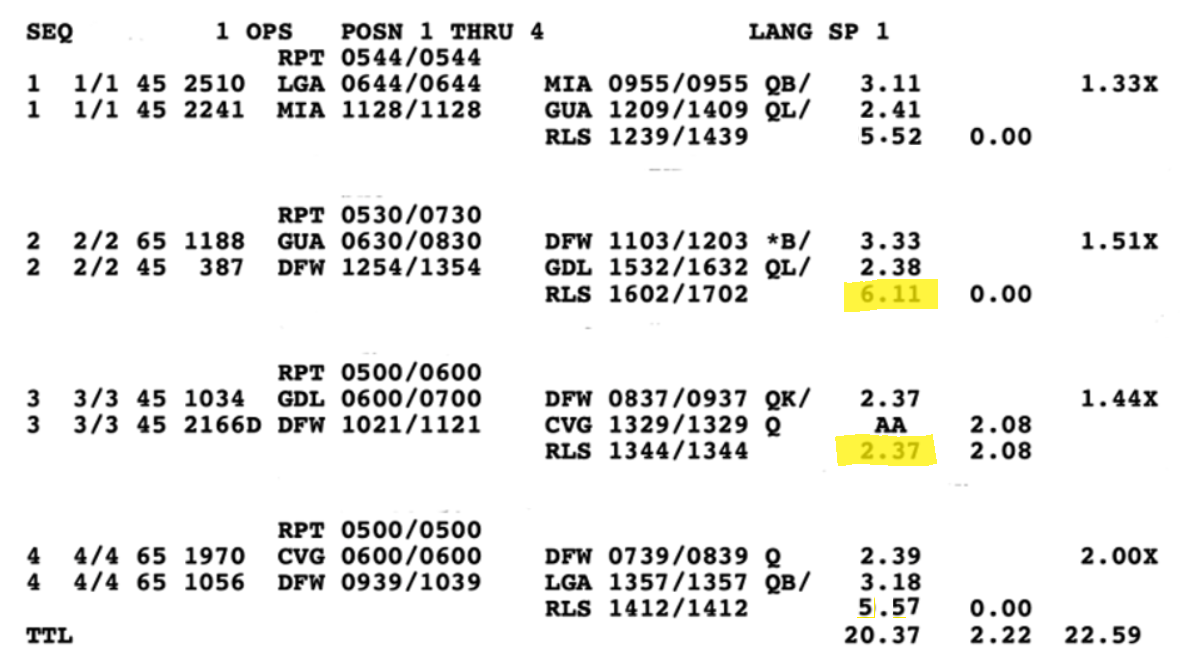
- Holiday Pay is only paid for the flight legs that touch the designated holidays. Holiday pay does not apply to the entire sequence unless each leg touches a holiday.
- If the departure or arrival of the leg (local station time) touches the holiday, you will be paid the holiday pay for that leg.
- “Flown” hours are block hours. Eligible hours are those scheduled within a flight leg that touches the holiday. Deadheads are credited block hours and, as such, are eligible for holiday pay.
- It is important to note that paid and credited hours as a result of duty, trip or minimum day rigs are not eligible for the holiday premium.
- ODAN Exception: Hours flown as a scheduled On-Duty All Night (ODAN) sequence in a single duty period that touches a holiday will be eligible for the holiday pay. This means that if you are on an ODAN that touches a holiday, you will be eligible for the holiday premium for the block hours flown on both legs of the sequence.
- Holiday pay is based on scheduled or actual. This means you will be paid the holiday premium on the greater of scheduled or actual flying time.
- If you were not originally scheduled to fly on the holiday, but as a result of a reschedule or an early or late departure/arrival the leg(s) flown now touch the holiday, you will be eligible for the holiday premium.
- Updated in 2024 CBA: If you were originally scheduled to fly on a holiday, but as a result of an early or late departure/arrival the leg(s) flown no longer touch the holiday, you will still receive the holiday premium.
- Updated in 2024 CBA: Flight Attendants serving airport standby and do no flying will be eligible for holiday pay. Standby hours within a shift that touch the holiday will be eligible. This means that if your standby crosses over midnight of the holiday, you are eligible for holiday pay for all standby hours on that shift.
- Updated in 2024 CBA: If you serve airport standby on a holiday and are assigned flying on the holiday day, only the flight hours touching the holiday are eligible for holiday pay. If you serve airport standby on a holiday and are assigned flying that departs on a non-holiday, you will be eligible for holiday pay for the standby hours only.
- Since holiday pay is based on hours “flown”, flights or trips that cancel or are removed will not be paid the holiday premium. This includes hours that are paid based on pay protections provided in the CBA.
- Flight Attendants who have a report/no fly event on a holiday will be eligible for the holiday premium on any applicable call out pay.
- For Last Live Leg Swaps (CBA 10.P), the Flight Attendant originally scheduled to work the flight will be eligible for holiday pay for the leg if it meets the above criteria.
- Holiday pay will not apply to CBA premiums such as Lead, Galley, International, Speaker, etc.
- Please note: December 1st, 2025 is part of the November bid month. December 2nd, 2025 is part of the December bid month.
- Holiday pay has no perfect attendance component; you just need to fly on the applicable holiday.
Thanksgiving Holiday Pay Examples


Christmas & New Years Holiday Pay Examples
Holiday Pay FAQs
Holding Time Pay
Holding pay is 30 minutes after scheduled departure posted at the moment you have passengers in your care.
- A Flight Attendant may be required to remain on duty with passengers on the aircraft at originating, intermediate, and terminating stations. Such required time on duty shall be considered “holding time” and shall not be considered as flight time for the purpose of flight time limitations.
- At originating and intermediate stations when the ground time exceeds the scheduled ground time by thirty (30) minutes, a Flight Attendant shall receive seven dollars ($7.00) per hour or fraction thereof, for all time spent with passengers, excluding ground time.
- At crew change stations when required to remain with passengers while waiting for replacements beyond forty-five (45) minutes, a Flight Attendant shall receive seven dollars ($7.00) per hour or fraction thereof.
Profit Sharing
For each profit sharing year, the Company will calculate profit sharing award payments as an amount equal to ten percent (10%) of Pre-Tax earnings up to $2.5B and an amount equal to twenty percent (20%) of Pre-Tax earnings above $2.5B for that year will be attributed to Percentage of Total Profit Sharing pool to be allocated to all eligible APFA represented employees by dividing the total eligible earnings of the APFA represented employees by the total eligible earnings of all participants in the American Airlines Group profit sharing program(s).
APFA Profit Sharing Pool will be divided by the amount of all the APFA represented employees’ eligible earnings and the result shall be the “payout percentage”. The amount of the award payment for each eligible APFA represented employee shall be the payout percentage multiplied by employee’s eligible earnings for the applicable year. Profit Sharing award payments shall be considered eligible income under AAG 401(k) plan. (CBA 3.R)
Understaffing Pay
Should a flight be dispatched with fewer than the number of Flight Attendants required by the staffing parameters in Scheduling, Section 10, each Flight Attendant working the flight will be compensated at the rate of ten dollars and fifty cents ($10.50) per credited hour, prorated to the nearest minute.
In addition, the Flight Attendants operating these flights/sequences may use expedited service procedures
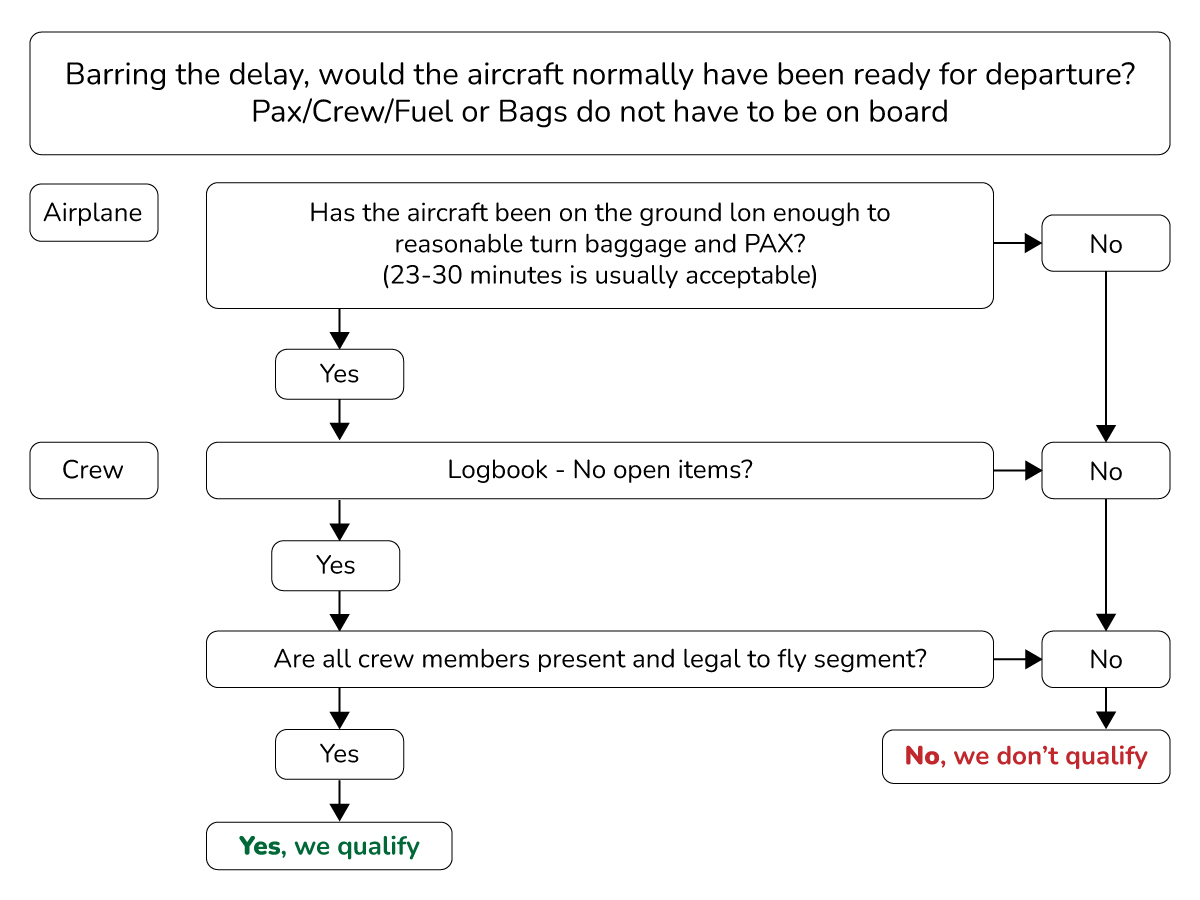
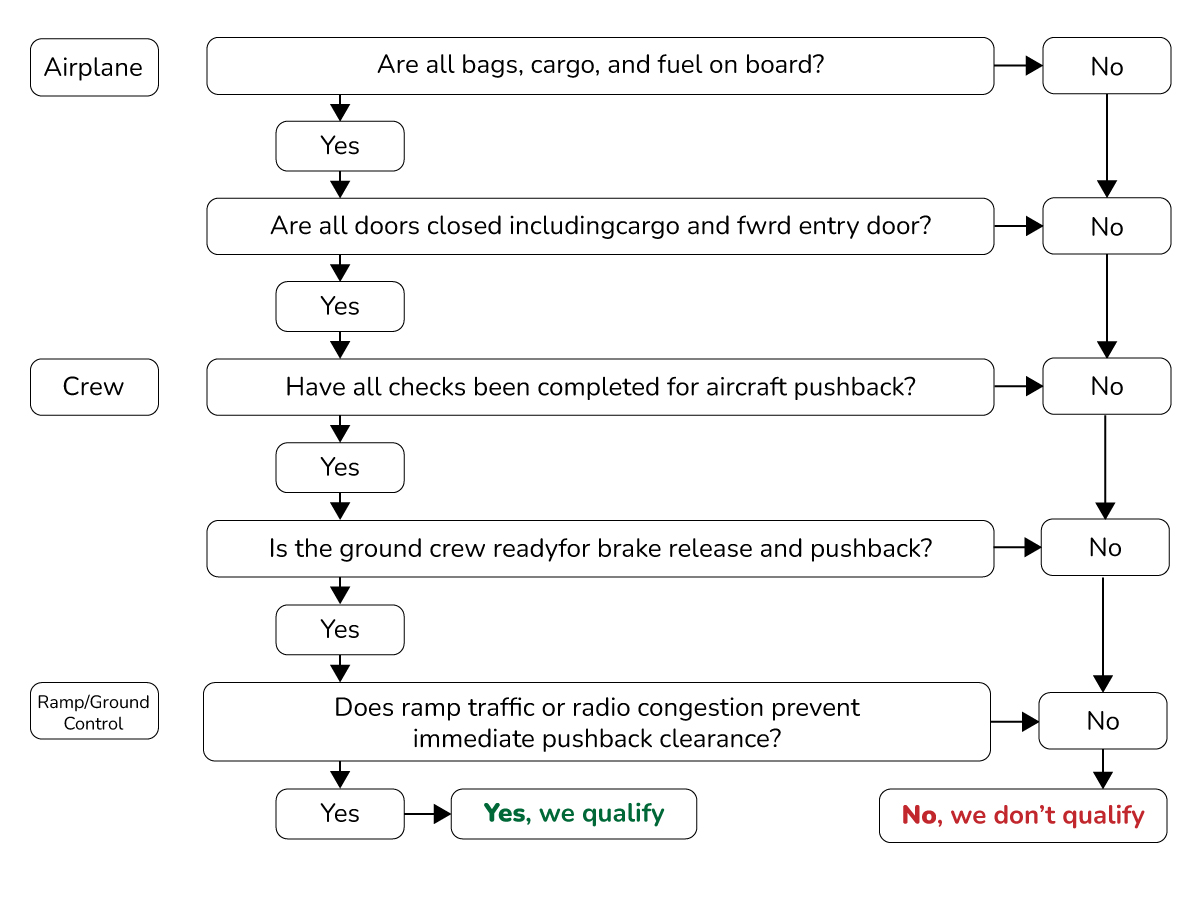
ATC Hold (Code 59)
ATC hold (or Code 59) is when the captain elects to delay starting the engines due to quoted take-off delays.
Flight Attendants will receive flight time pay and flight time credit prior to the actual time out.
ATC (or Code 59) means you'll be paid flight time and credit from the point at which the aircraft was ready for immediate departure under the following situations:
- Delay at the gate awaiting pushback, power back or taxi out due to airport congestion.
- Deicing.
- Maintenance performed after departure from the gate but prior to take-off.
- Delay at the gate awaiting pushback, power back or taxi out due to congestion with deicing operations off the gate. – CBA 3.M.
Code 59 scenarios for ATC and Ramp Delays
RFD Scenario 1 - ATC Delay
RFD Scenario 2 - Ramp Delay
Checklist for Flight Deck for Entering Code 59 for Qualifying Scenarios
Access Menu
— Navigate to the main system menu
Select ATC COM
— From the menu options, choose ATC COM
Choose ATSU
— Within ATC COM, select ATSU
Select AOC AAL
— Proceed to AOC AAL
Navigate to Second Page
— On the left-hand side, locate and open the second page
Enter Time Out RFD
— Input the time out RFD accurately
Press SEND
APFA Headquarters
1004 West Euless Boulevard
Euless, Texas 76040
M-F: 9:00AM - 5:00PM (CT)
Phone: (817) 540-0108
Contract & Scheduling Desk
M-Th: 9:00AM - 5:00PM (CT)
Phone: (817) 540-0108
Live Chat Messaging
Fridays: 9:00AM - 5:00PM (CT)
Currently, no scheduled events...