

3.20.26 – Treasurer’s Update: 3Q Financial Status and the FY27 Budget
Friday, March 20, 2026
Treasurer’s Update:
3Q Financial Status and the Fiscal Year 2027 Budget
In this hotline:
- FAQ’s Before We Begin: How is the APFA yearly budget created and approved?
- Third Quarter Financial Update
- 2026-2027 Fiscal Year Budget
- How the Budget Was Built
- What This Means
- Budget Committee – Thank You!
- Bottom Line
Earlier this month at the Annual Convention, I provided a third-quarter financial update and presented the budget adopted for Fiscal Year 2027. Because we are still in the fourth quarter, this is not our final year-end financial report. I will provide a full annual financial update once the independent audit is complete and our LM-2 has been filed later this summer.
My last hotline update in October focused on the prior fiscal year and provided an update on dues income and arrears recovery. This update builds on that report by giving the Membership a clearer picture of where APFA stands through the third quarter, why this year’s budget process was especially difficult, and what the approved budget means moving forward.
FAQs Before We Begin: How Is the APFA Yearly Budget Created and Approved?
Q1: How do we create the budget for each upcoming fiscal year?
At least 60 days prior to the Annual Convention, the National Budget Committee begins building a proposed budget by looking at both sides of the equation: the income we expect to bring in, and the expenses required to run the Union and provide services to the Membership.
- Income
- We review the current headcount, factor in any projected hiring, and work with our financial advisors to project investment income.
- Special Fund Activity
- We initially subtract $4 from every $41 projected to be received and allocate it to the Negotiations and Negotiations-Related Fund (NNRF), which is our mandatory savings account reserved for negotiations and restricted from general use.
- We then determine what activities are anticipated and whether any of our other special funds need to be funded or replenished. These include arbitrations, education and training, litigation, meetings and events, and voting and elections.
- Expenses
- We begin with fixed costs (salaries and benefits, operating costs such as Headquarters UAW-represented Staff salaries, building/maintenance costs, technology and vendor contracts, and other operational necessities).
- We then determine the cost of removing and paying Union representatives, which is driven by the CBA.
- Next, we use the same headcount used to project income to determine how much is allocated to the base budgets, which includes trip removals, expenses, and reimbursements. This is required under APFA Policy Manual Section 5.C.8.
- Lastly, we distribute any remaining surplus or deficit across the budgets. This year, however, a tiered reduction was applied only to select budgets at Headquarters, as well as National Departments, Committees, and Specialists.
- Overall Review
- We also review prior-year spending, current-year trends, projected headcount, known cost increases, and any major operational or contractual obligations that will affect the next fiscal year. From there, different budget options can be developed based on the financial realities the Union is facing at that time.
Q2: What role does the APFA Budget Committee play?
The APFA Budget Committee plays both an advisory and working role in the budget process. Committee members review the Union’s finances, ask questions, examine trends, discuss priorities, and work with the Treasurer and Accounting Department to help develop budget recommendations or options for consideration.
The Committee brings Member involvement, perspective, and oversight into the budgeting process. It also helps ensure that the process is informed, transparent, and grounded in the financial realities facing the Union.
Q3: How is the final budget debated and ultimately chosen?
Once the budget is developed, it is presented to your elected Base Presidents for discussion and debate. That is where the Base Presidents review the proposal, ask questions, debate priorities, offer amendments or alternative approaches, and ultimately vote on the budget.
While the Budget Committee helps develop and recommend a budget, and sometimes multiple budget options, the final approved budget is the one that is ultimately passed by your Base Presidents. That final vote determines the priorities and direction of the Union for the fiscal year.
Third Quarter Financial Update
By the end of the third quarter, APFA should have reached about 75% of our annual budgeted income, or roughly $10.7 million. We billed $10.26 million, which was about 96% of target and reflects the continued impact of higher attrition than we made allowances for.
Unfortunately, of that amount, we only collected $9.43 million, or about 92% of what was billed. Our poor income performance is driven by:
- Members who take a leave and don’t pay upon returning to the line;
- Members provided a dues exemption credit for certain leave types from the 2014 constitutional change;
- Member defaults on the new Payment Arrangement policy.
Arrears collections brought in an additional $651,960 and helped close part of the gap, but even with those efforts, we still ended the quarter at only about 94% of where we needed to be, leaving us $617,218 below our income target.
That reality continues to put real pressure on the Union’s finances and is one of the reasons this year’s budget process was so difficult, while also underscoring how important dues arrears recovery remains in helping stabilize our financial position.

On the expense side, we remained disciplined and within budget. Through the third quarter, APFA spent $9.91 million, which was right on target with our expense goal. After accounting for expenses reimbursed through designated special funds—including arbitrations, meetings and events, negotiations work tied to the CIC and ongoing CBA implementation, voting and elections, litigation, and education and training—$426,562 was reimbursed from those special funds. That brought our actual operating expenses down to $9.49 million, or about 3.23% below budget.
Staying on track with expenses matters, but it does not tell the whole story. It shows that we are being responsible and careful with your hard-earned dues money. But it does not mean the pressure is gone. Simply put, staying under budget has required discipline and restraint across the Union, not comfort. It has also required strong dues arrears recovery efforts, which continue to play a major role in helping keep APFA financially stable. That work is helping close the gap right now, but it is not a permanent fix for an ongoing income problem. As arrears collections slow, outstanding balances are reduced, more members fall into arrears, and fixed costs continue to rise, the underlying pressure on the budget and on services will remain.
That is one of the reasons this year’s budget process was so difficult.
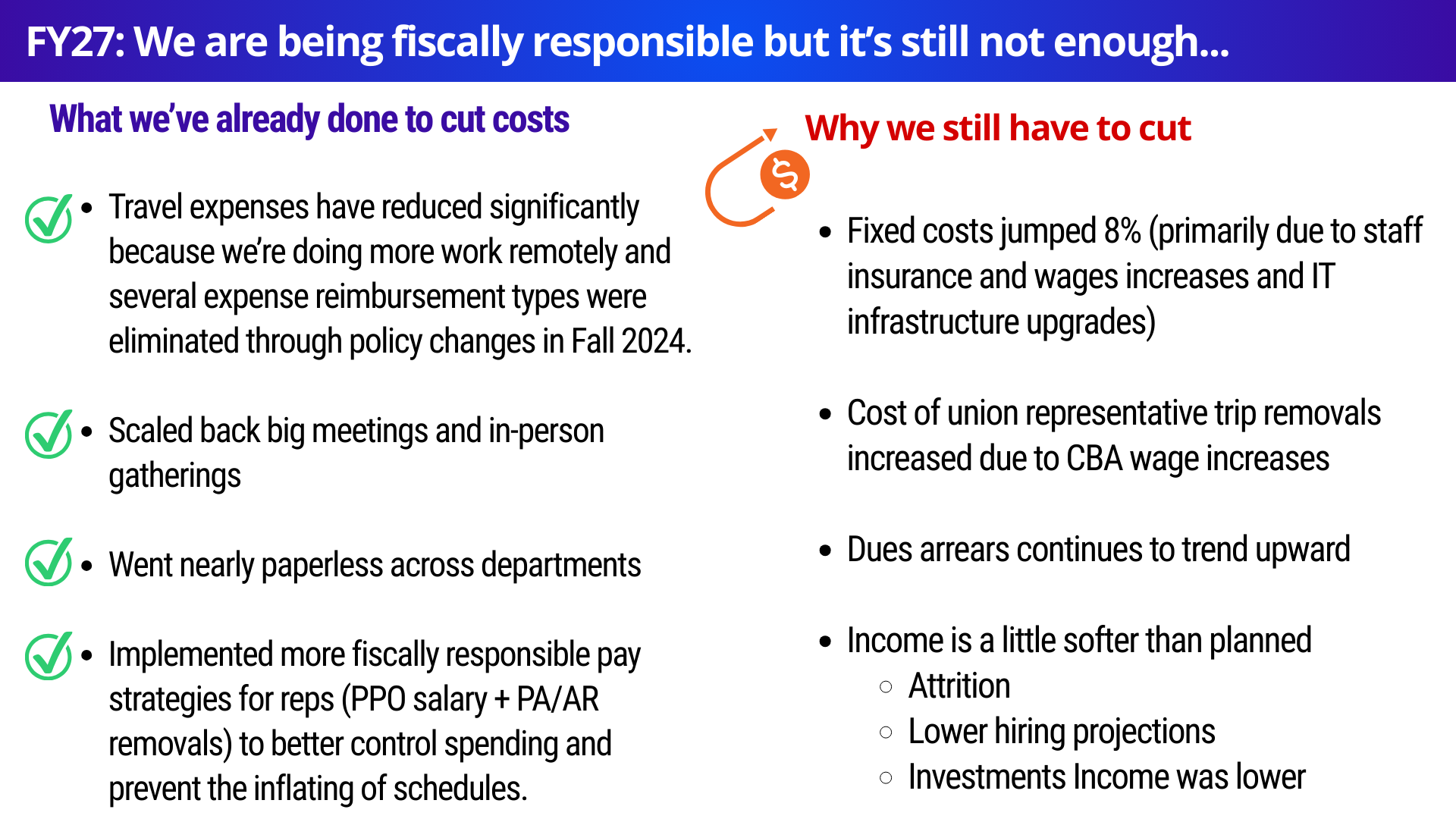
The challenge in building the Fiscal Year 2027 (April 1, 2026 – March 31, 2027) budget was not overspending. The challenge was that projected income declined while the cost of operating the Union continued to rise, driven by increased wages under our CBA. Union representatives are compensated at their applicable hourly rate in accordance with Section 3 of the CBA.
Projected income is down 2.59%, driven largely by higher attrition and lower hiring than we saw in the 2025-2026 fiscal year. On the expense side, fixed operating costs increased by 8%, and the cost tied to each representative has also increased in line with the applicable wage increases under the CBA.
Those fixed operating costs include the things required to run the Union and provide services to the Membership, including Headquarters UAW-represented Staff salaries and health benefits, building repairs and maintenance, property taxes, insurance, IT systems, website and software vendors, and other essential administrative and operational support. These are not extras. They are part of the infrastructure required to keep APFA functioning and to support representation, legal representation for the organization, Member services, communications, technology, data, accounting, dues administration, and office operations
At the same time, we have continued to cut costs where possible. The issue we are facing is not excessive spending, but rather the lack of sufficient income.
The Budget Committee presented three options to your Base Presidents for the Fiscal Year 2027 (April 1, 2026 – March 31, 2027) budget.
Because of the reduction in projected income, the decline in investment income, the increase in fixed and operating costs, and the increase in representative-related costs, the Union could not pass a balanced budget without making cuts somewhere.
Under the budget that was voted in by your Base Presidents, those cuts were mostly absorbed by Headquarters, National Department, National Committees, and National Specialist budgets.
Base Budget Formula
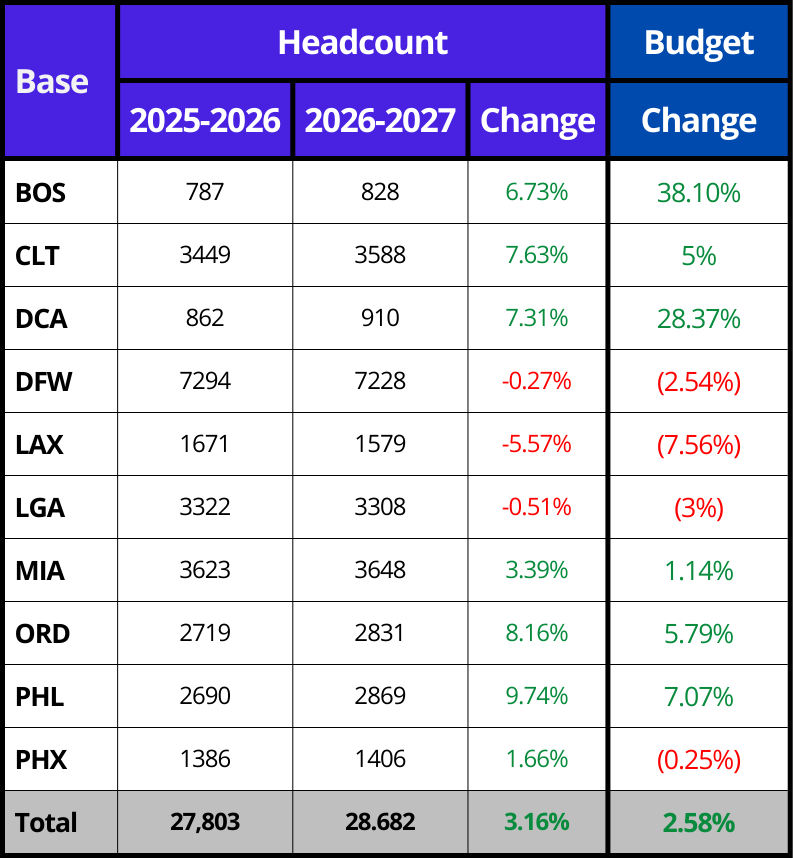
APFA Policy Manual Section 5.C.8 requires base budgets to be allocated according to headcount. That means base budget changes are driven by the Membership numbers used in the allocation formula.
When the projected April 2026 headcount was applied, the bases received an overall increase of 2.58%. That does not mean every base increased equally. It means the total allocation to the bases increased overall, while individual base budgets moved up or down based on the formula.
Another important factor in this year’s base budget discussion was the minimum trip removal threshold change.
At the Fall Board meeting this past October, your Base Presidents passed Resolution #4 which provided any base whose headcount fell below the 1130 with one full trip removal (currently BOS and DCA). At the Annual Convention, that threshold was increased to 1150.

Budget Reduction Tiers
Since the budget had to be balanced and reductions had to be made, a tiered cut structure was used to determine how those reductions would be absorbed. Rather than applying the same cut across every budget, the tier system was designed to distribute reductions in a way that accounted for the size of the budget being reduced.
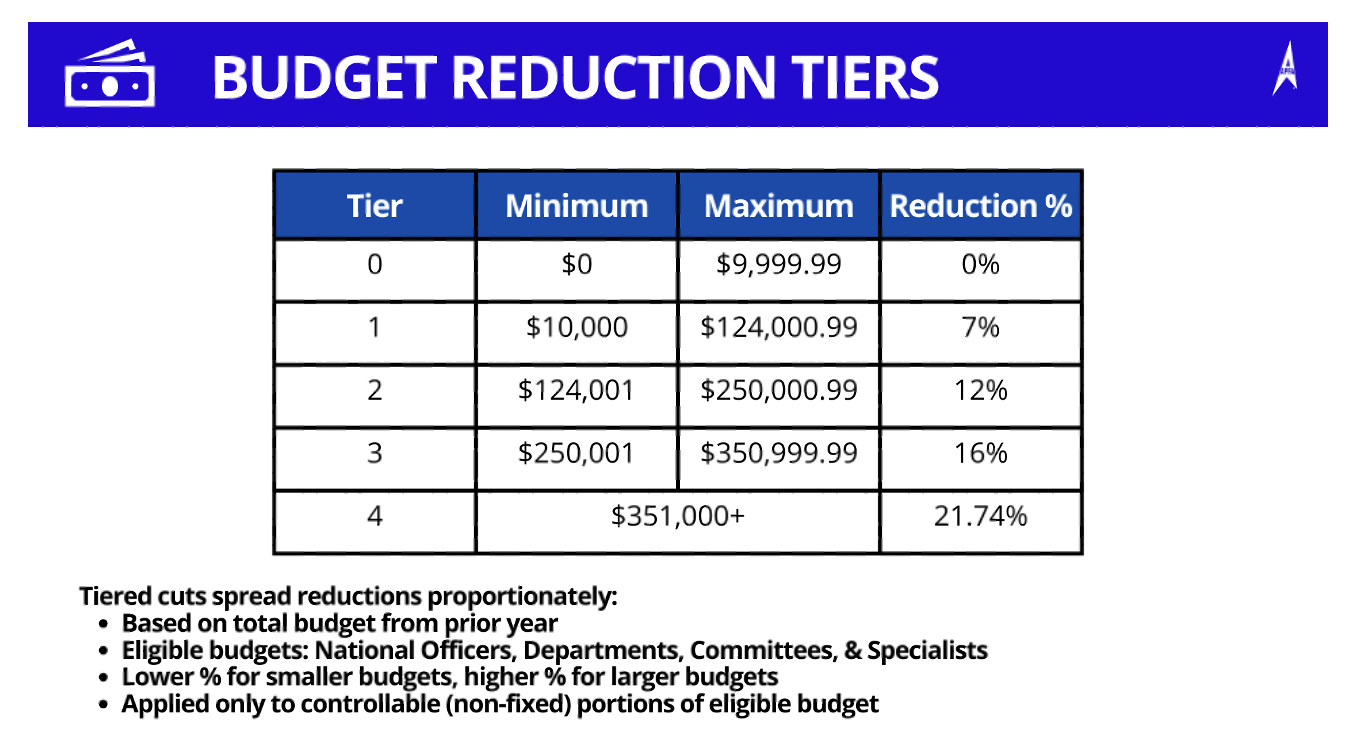

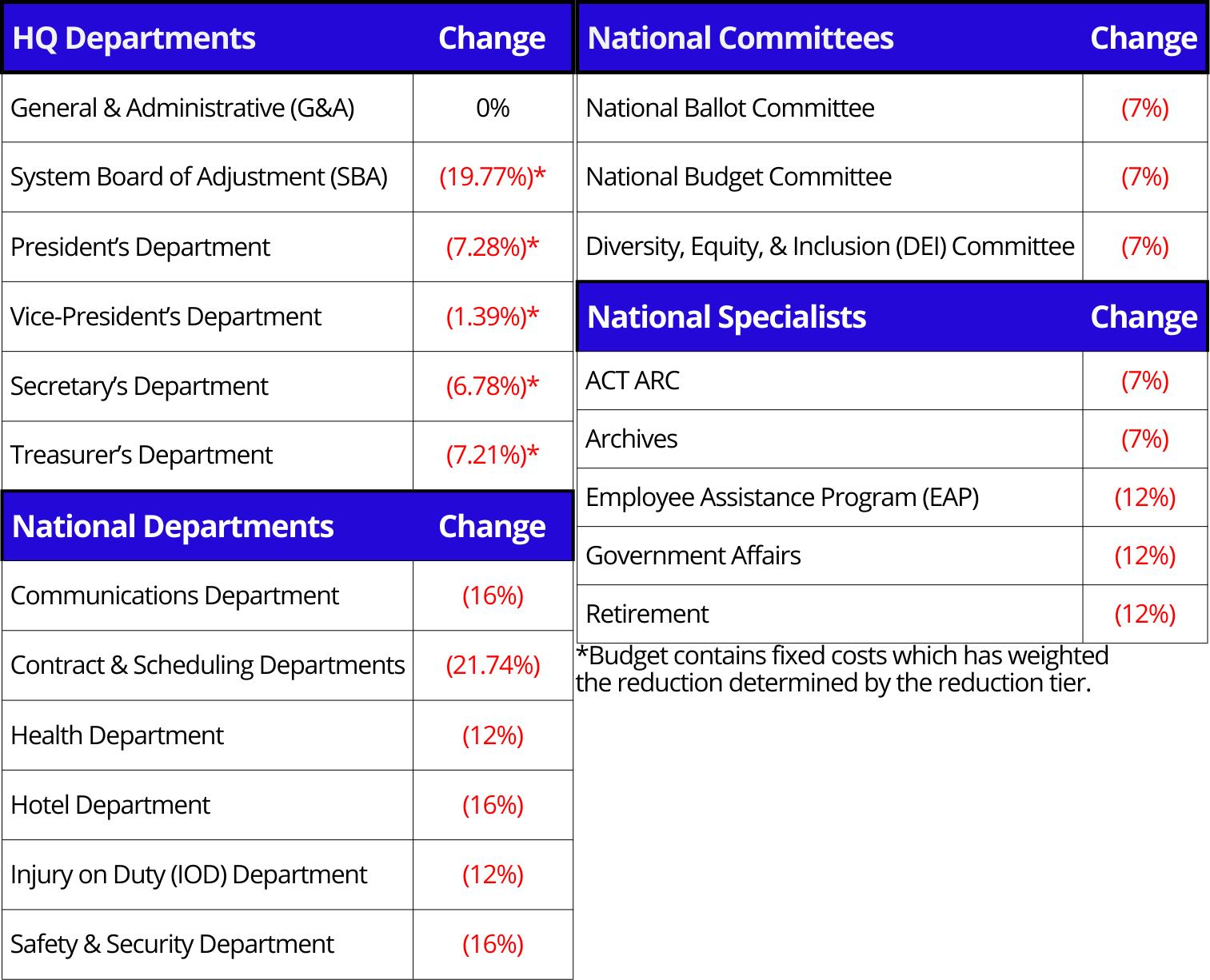
With the reductions absorbed by Headquarters, National Departments, National Committees, and National Specialist budgets, that has a real impact on the level of support those areas can provide.
For many Members, Headquarters and National Departments are where they turn for help with contractual questions and company policy guidance. Base representatives play an essential role as well, particularly in local representation for disciplinary meetings
A significant part of the discussion during this budget cycle centered on the increase in disciplinary meetings at the base level and the position that additional resources were needed there to meet those representation demands. Because APFA will always provide representation in these matters, the approved budget preserves a greater share of the Union’s limited resources in support of the base structure, while reducing resources in many of the headquarters-based functions that serve Members every day.
As a result, you may experience slower response times, reduced availability, and a lower level of support. Headquarters and National Departments will continue to assist Members, but you may experience delays and may need to contact your Base Representatives for more immediate help on certain questions or concerns.
I also want to sincerely thank the Members of the APFA National Budget Committee, both those continuing to serve and those whose service has come to a close, for their service, hard work, and commitment over the last two terms. This Committee played an important role in some of the most significant work we have done as a Union in the past two terms and brought together a broad range of voices, perspectives, and experiences in service to the Membership. Much of that work happened behind the scenes. It was detailed, difficult work, and all of it was done without any compensation. I am deeply grateful for the time, care, and effort each Member brought to this work.
- Income continues to come in below what we projected.
- Dues arrears recovery continues to play an important role in helping stabilize our financial position. Even after such significant dues arrears collections since September 2022, our dues arrears balance has crept back up to $1,787,439, of which:
- $414,276 is made up of current Members in dues arrears (the Delinquent Dues Procedure is in process as outlined in CBA 35.F and Policy Manual Section 2.A.3),
- $636,610 is made up of Members currently on a leave, and
- $736,553 includes former Members who are no longer on property. (Former Members’ balances have been turned over to our collection agency for payment).
- Expenditures remain as low as possible and within policy. But with Membership income down, investment income down, fixed and operating costs rising, and representative costs increasing under the CBA, this year’s budget required difficult decisions.
The budget that passed reflects those realities.
As always, my goal is to provide you with honest, transparent, and understandable financial information, not just about the numbers themselves, but about what those numbers mean for the Union and the services provided.
I will provide a full year-end financial update once the annual audit is complete and the LM-2 has been filed later this summer.
In Solidarity,

Erik Harris
APFA National Treasurer
[email protected]

APFA Headquarters
1004 West Euless Boulevard
Euless, Texas 76040
M-F: 9:00AM - 5:00PM (CT)
Phone: (817) 540-0108
Contract & Scheduling Desk
M-Th: 9:00AM - 5:00PM (CT)
Phone: (817) 540-0108
Live Chat Messaging
Fridays: 9:00AM - 5:00PM (CT)
Currently, no scheduled events...