

4.06.26 – APFA CLT Base Brief – May 2026 Staffing and Allocations
May 2026 Staffing and Allocations
Monday, April 6, 2026
We held our monthly scheduling call with the company to review the May schedule.
May 21 marks the start of the summer schedule. The build-up has been underway for several months, and with the addition of ATH service in May, our IPD summer schedule will be fully in place. A schedule change on May 21 will introduce the majority of summer flying, bringing us to a full nine-bank operation.
For the first three weeks of the month, the ninth bank will continue to be removed on Tuesdays. This is reflected in the monthly time distribution, with Tuesdays operating only eight banks and a corresponding reduction in trips. Outside of Tuesdays, daily flying remains relatively consistent with minimal fluctuation. Once the full nine-bank schedule is implemented, the remaining flying hours will be added, stabilizing the schedule for the summer months, with only minor increases expected around holidays.
Total flying hours for May will increase to 212,813—approximately 6,000 more hours than April. This increase is driven by the return of ATH service and the transition to a full nine-bank schedule.
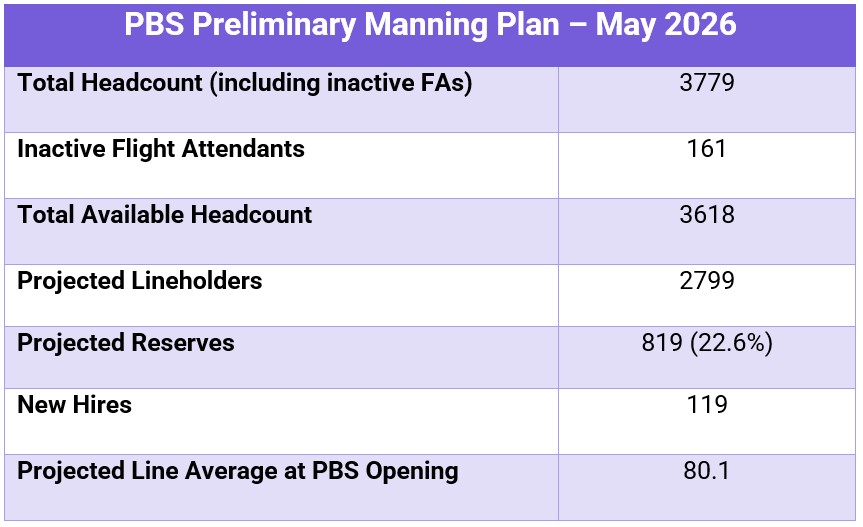
Due to the increased flying and corresponding staffing needs, the company was unable to offer any VLOAs for May. The line average will rise slightly to 80.1 hours. Reserve staffing will increase to 819, representing 22.6% of the base. While this is an increase in total reserves, it reflects a year-over-year decrease in percentage, compared to 852 reserves (25.3%) last year.
In May, 119 new hires will join the base, helping offset reserve rotations. The projected reserve cutoff will be September 7, 2023. Of those new hires, only 63 are included in the official reserve count. When factoring in the remaining 56, the true reserve percentage is closer to 24%. While still lower than previous years, this highlights the continued reliance on new hires without fully accounting for them in the total available reserve pool.
Overall, staffing levels are solid for the projected schedule, and the line average remains manageable. As flying hours increase, the line average will naturally rise. Additionally, May marks the start of a new vacation year, with increased vacation allocations. Higher vacation usage also contributes to an increase in the line average.
May Schedule Overview – Key Highlights
- Two schedule changes in May:
- May 6: Minimal impact; barely noticeable.
- May 21: Major schedule change with significant system adjustments.
- Aircraft repositioning during schedule changes:
- Results in one-time trips built into the schedule.
- Increased use of multi-day trips (especially 3-days) to absorb added flying time.
- System is designed to build more productive 3- and 4-day trips with additional legs.
- Trip construction trends:
- Increase in 3-day trips driven by system productivity goals.
- Similar patterns typically seen during holiday peak periods (e.g., Thanksgiving, Christmas).
- Company uses constraints and targets to prevent excessive multi-day trip construction.
- Overall, trip distribution and structure shift noticeably in May.
Trip Distribution Breakdown
- 1-Day Trips: 20% (↓ from April’s 24%)
- 2-Day Trips: 18% (↓)
- 3-Day Trips: 33% (↑)
- 4-Day Trips: 3.4% (≈ same)
- 2/3-Day Trips: 15% (↓)
- 3/4-Day Trips: 2% (↓)
Flying Types & Trends
- ODANs: Slightly up
- Red Eyes: Slightly up
- Pink Eyes & Bullets: Essentially unchanged from April
Trip Type Analysis
1-Day Trips
- Down overall from April.
- 25% are now 4-leg days (increase in workload per trip).
- Fewer total 1-days, but more demanding when they occur.
2-Day Trips
- Still considered the most desirable trips.
- Reduced to 18% due to system shifting flying into 3-day trips.
- Reflects company push toward higher productivity (“hard time”) trips.
3-Day Trips
- Largest increase after several months of decline.
- Built to absorb schedule changes and increased flying hours.
- Key concerns:
- 24% include sit times over 2+30 hours.
- Longer duty days and shorter overnights.
- More fragile construction, increasing likelihood of trips breaking during IROPs.
4-Day Trips
- Percentage remains stable.
- Slight improvement in commutability.
- Generally less leg-intensive per day than 3-days.
- Some trips are commutable on the front end but not the back end.
2/3-Day and 3/4-Day Trips
- Slight decrease.
- With the system nearing full capacity, there is less need for extended layovers.
- More efficient scheduling allows:
- Legal overnight rest
- Immediate continuation the next day
- Longer sits are more common during reduced schedules (e.g., winter or bank reductions).
ODANs (Overnight Duty Assignments)
- Slight increase overall.
- Strongly tied to number of banks of flying:
- Fewer ODANs when Bank 9 is removed (e.g., Tuesdays).
- Expected increase with full 9-bank schedule.
- Most activity seen on weekends, especially Saturdays.
- Still limited by company-imposed constraints, despite network suitability (e.g., CLT).
Red Eyes
- Slight increase due to expanded schedule and more West Coast flying.
- Typical structure:
- Out-and-back or
- Hub connection outbound + direct return
- No significant increase in turns at the start of Red Eye sequences.
Pink Eyes & Bullets
- No change from April.
- Expected to remain consistent through summer.
- Possible slight increases as full summer schedule ramps up in June.
May 2026 Bidding Timelines
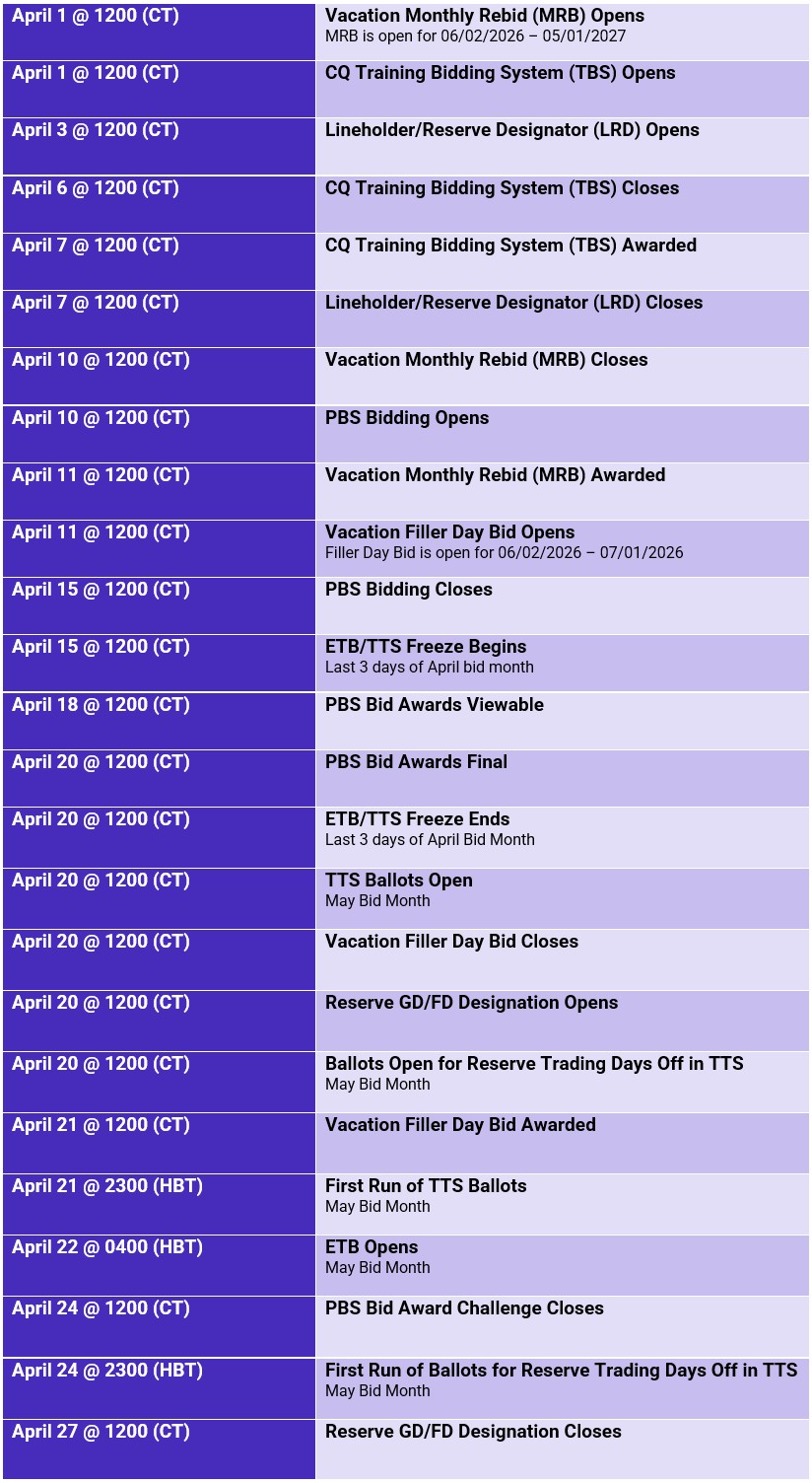
We have been steadily increasing our base over the past few months as we transition out of winter and into the summer schedule, with May marking the completion of the full summer flying schedule. The company began this phased approach two years ago, and it has proven to be a far more effective way to ramp up flying compared to the abrupt jump we used to see in June.
That said, the trips themselves have not fundamentally changed. The company continues to rely on a construction model that is prone to breakage. Like many of the systems currently in use, it has clear limitations, and those shortcomings are reflected both in the structure of the trips and in the outcomes when disruptions occur.
We would prefer to see greater investment in improving the underlying technology—particularly tools like the optimizer that directly impact trip reliability. Instead, resources continue to be directed toward programming that feels more focused on discipline and complexity, along with additional layers of management to enforce it.
Investing in the passenger experience and building a more reliable network would deliver far greater long-term value. It’s hard to point to any company that became an industry leader by prioritizing discipline over the quality of its product.
Take care of yourselves and each other.
The Charlotte APFA Team
In Solidarity,
Scott Hazlewood
APFA CLT Base President
[email protected]
Frank Cagle
APFA CLT Base Vice President
[email protected]
APFA CLT: (704) 665-7474

APFA Headquarters
1004 West Euless Boulevard
Euless, Texas 76040
M-F: 9:00AM - 5:00PM (CT)
Phone: (817) 540-0108
Contract & Scheduling Desk
M-Th: 9:00AM - 5:00PM (CT)
Phone: (817) 540-0108
Live Chat Messaging
Fridays: 9:00AM - 5:00PM (CT)
Currently, no scheduled events...