

6.07.26 – APFA CLT Base Brief – July 2026 Staffing and Allocations
July 2026 Staffing and Allocations
Sunday, June 7, 2026
We recently met with management to review the July schedule, and there were no major surprises. July is the peak of the summer travel season, driven by the Independence Day holiday and strong seasonal demand. As a result, our flying has increased to 223,024 hours—the highest level we have seen. This growth is largely due to the Company spreading flying across the bank structure and adding flights where increased summer demand supports expansion. Our international flying (IPD) will operate a consistent schedule throughout the month, with no significant departure-time adjustments as seen in other months. The July schedule change takes effect on July 2, the first day of our bid month, and reflects a stable operation with nine full banks. The only planned reductions are on July 8 following the holiday rush, with smaller reductions on July 21 and July 29.
Demand remains strong this summer, fueled in part by travel associated with the FIFA World Cup and other seasonal events. American Airlines is clearly positioning itself to capture that demand, though there are concerns about whether the operation may become stretched during peak periods. A schedule of this size places increased demands on aircraft utilization, maintenance resources, and operational reliability, while summer weather always adds an additional layer of unpredictability. To prepare, the Company has increased reserve staffing and raised the line average. The significant hiring conducted this spring appears to be part of a broader strategy to support an aggressive summer operation and maintain staffing levels heading into the fall and winter holiday travel seasons.
Reserve Staffing
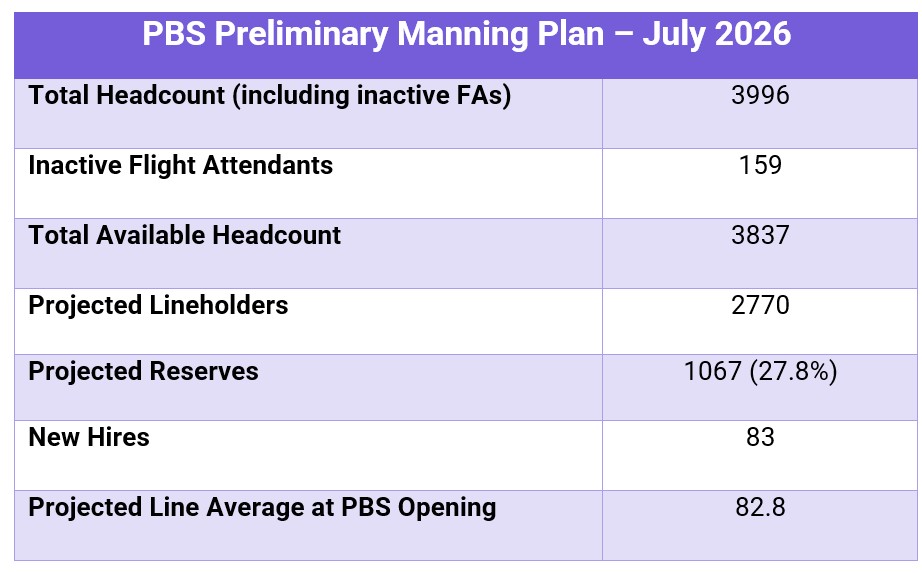
Reserve numbers remain elevated for July; however, the addition of new hires has lowered the reserve rotation cutoff. This is likely the most junior reserve rotation cutoff our base has experienced.
While reserve utilization has remained relatively stable month-over-month, staffing levels are being driven more by operational planning than actual reserve usage. July is one of the busiest travel months of the year, and the Company is staffing conservatively to prepare for potential disruptions. Charlotte continues to maintain strong attendance numbers with relatively low vacation usage. Reserve allocations are based largely on historical summer demand and the need to protect the operation during peak travel season.
July Schedule Overview
Our July schedule has been building toward this point for several months. In many ways, July resembles June—but on a much larger scale. With only one significant schedule change occurring at the beginning of the month, aircraft routings remain highly consistent throughout the bid period.
This consistency allows the optimizer to build more stable pairings rather than creating new trip patterns every week. As a result, trip construction and distribution remain very similar to what we’ve seen in recent months.
Trip Distribution
1-Day Sequences – Approximately 20%
- Slight increase from previous months.
- The Company continues its push toward more 1-day pairings.
- About 25% of these trips are still four-leg sequences.
2-Day Sequences – Approximately 20%
- Increased as part of the Company’s effort to create more 1- and 2-day pairings.
- Other bases saw more significant increases in 2-day trips.
- Charlotte’s increase was more balanced between both 1- and 2-day sequences.
3-Day Sequences – Approximately 32%
- Slight decrease from previous months.
- A positive indication that additional flying is being shifted into shorter pairings.
- Continue to have the highest sit times.
- Generally contain more legs per duty day than other sequence types.
4-Day Sequences – Just Under 2%
- Continue to decrease in overall percentage.
- Commutability remains relatively favorable despite the reduction.
2/3-Day Sequences – 14.7%
- Slight decrease from previous months.
- A stable schedule with minimal schedule changes reduces the need for these mixed pairings.
3/4-Day Sequences – 1.4%
- Also slightly lower than previous months.
ODANs – 6.4%
June was the first month where we fully felt the impact of the new contractual requirement mandating a minimum six-hour rest period on ODANs. Many short-haul ODAN opportunities have disappeared because later departures and earlier returns no longer allow for the required rest period.
This trend continues into July, resulting in fewer ODANs being built compared to previous years.
Red Eyes, Pink Eyes, and Bullets
Red Eyes – 3.5%
- Essentially unchanged from June.
- Consistent West Coast scheduling has helped keep these pairings balanced throughout the month.
Pink Eyes and Bullets – Under 1%
- Remain largely unchanged and continue to represent a very small portion of total flying.
Overall Assessment
The biggest change in July is not the distribution of trips but the amount of flying. Pairing construction remains remarkably consistent with what we’ve seen over the past several months.
The Company’s continued push toward additional 1- and 2-day sequences is a positive development, particularly during the summer months when weather-related disruptions become more common. Shorter pairings provide greater flexibility during irregular operations and can be easier to recover operationally when the system experiences disruptions.
Historically, shorter sequences have also contributed to improved attendance trends, as Flight Attendants are generally less likely to call out on a single-day sequence than on a multi-day trip.
Bidding Considerations
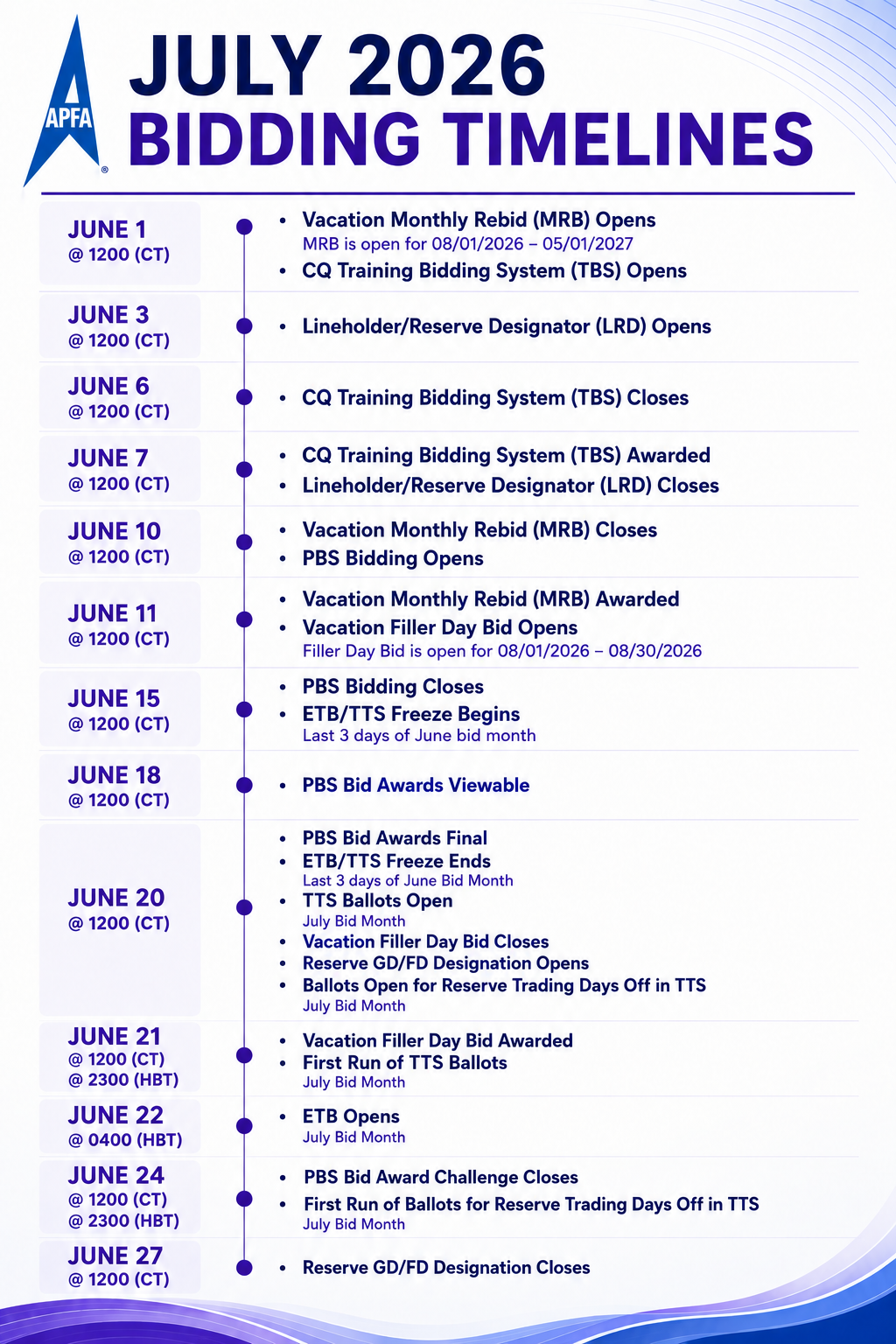
The July line average is higher than previous months, so be sure to account for that when planning your bids.
Additionally, the critical coverage period runs from July 1 through July 7. Remember that July 1 is still part of the June bid month, so keep this in mind when planning trip removals, vacation usage, or other schedule adjustments.
The July schedule offers a healthy mix of flying opportunities, but it also comes with challenges. The current construction model has increased the number of flight legs and leaves very little margin for disruption from weather, maintenance delays, or other operational issues. This summer will be a critical test for American Airlines, and there is a great deal riding on the success of the operation.
As we move into the peak travel season, remain focused on safety above all else. Summer weather brings an increased risk of turbulence, and the new descent and landing procedures represent a significant operational change that many passengers may not fully understand. Protect yourself by following established procedures, documenting issues when they arise, and maintaining awareness of your contractual rights. Stay vigilant, stay informed, and look out for one another. It promises to be a busy and demanding summer.


APFA Headquarters
1004 West Euless Boulevard
Euless, Texas 76040
M-F: 9:00AM - 5:00PM (CT)
Phone: (817) 540-0108
Contract & Scheduling Desk
M-Th: 9:00AM - 5:00PM (CT)
Phone: (817) 540-0108
Live Chat Messaging
Fridays: 9:00AM - 5:00PM (CT)
Currently, no scheduled events...