

3.13.25 – APFA CLT Base Brief – April 2025 Staffing and Allocations

April 2025 CLT Staffing and Allocations
Thursday, March 13, 2025
Last week, we held our monthly call with the company to discuss the trips planned for April. This week, we also met with CLT Operations to go over the plans for the upcoming summer flying season. We wanted to align our expectations for the summer with any surprises that might arise.
You might remember last summer, which was characterized by crammed flights, packed concourses, and disgruntled passengers—an experience that was far from pleasant, especially when the weather didn’t cooperate. As a result, our satisfaction numbers reflected this difficult reality. We braced ourselves for another hectic summer filled with an unrealistic schedule. However, upon reviewing the April trips, we noted a reduction in the number of trips but an increase in flight hours, which will rise to 183,416. The main change involves the addition of IPD flights, which account for about 5,000 hours for one monthly flight.
So, what’s going on? We anticipated a gradual increase in flying hours transitioning from the winter schedule to the summer schedule in June, with April serving as the initial step into a “spring” schedule. The good news is that Charlotte will implement a more manageable schedule throughout the spring and summer months. This new plan is realistic given our capacity to operate the scheduled flights and serve our passengers effectively. It seems we’ve learned from our past experiences and understand that we cannot sustain such a hectic pace in the long term for the survival of both the Hub and American Airlines. It was refreshing to hear this perspective, especially since management in the Inflight Department seldom takes accountability for their previous failures.
What does this mean for CLT? First, there’s no need to panic. Charlotte remains a valuable asset in the American Airlines portfolio and continues to be a profitable operation. This isn’t a sign of downsizing. The majority of the reductions will involve flights transitioning back to the regional side. For instance, if mainline operations had 405 departures a day last June, this year we will have 367, but the regional side will increase its departures per day. American Eagle now has the necessary airplanes and pilot staffing, so many of the shorter flights we’ve been handling for the past two years will return to regional flying.
These reductions will also be evident on Tuesdays, Wednesdays, and Saturdays with pull-downs in the banks of flying, similar to what we see in the winter schedule. Additionally, we will see pull-downs on banks 7 and 8 on various days throughout the month and week. Banks 7 and 8, being evening banks, are particularly vulnerable to the impacts of earlier weather events. While we will maintain nine banks, they will be managed more effectively.
Furthermore, there will be a decrease in the number of “out and back” flights from the hub, and Security Checkpoint 2 will reopen, eliminating the walled-up section leading to the D gates. With 183,000 hours still on the table, we expect to see small increases as the last IPD flights go into operation in June. We are also anticipating a surge in travel around the Fourth of July, as expected.
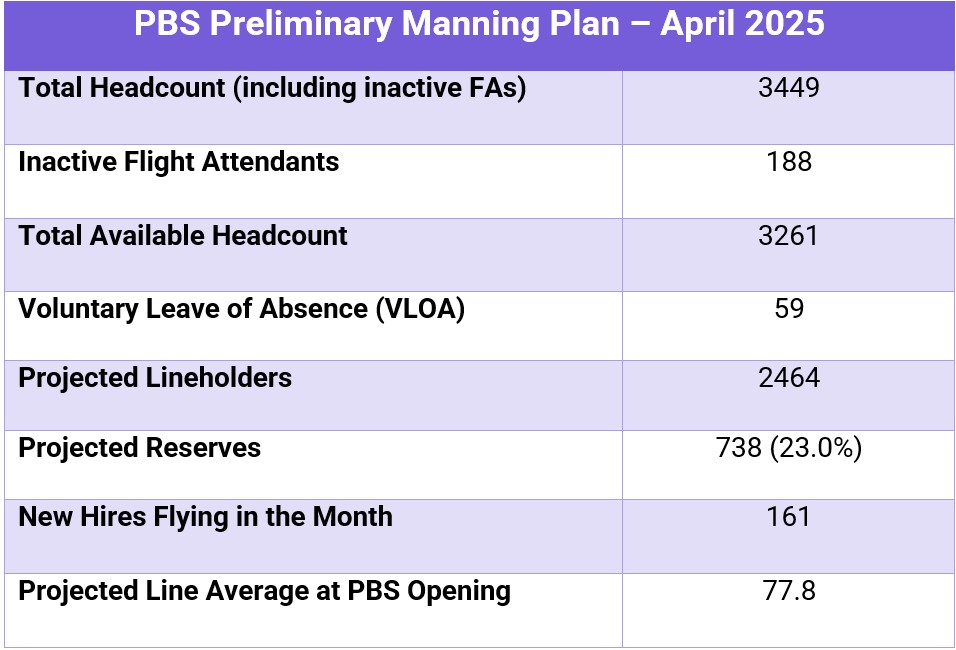
Our numbers remain strong, with a total of 2,144 trips recorded, down from 2,519 in March. This reduction in trips is attributed to fewer bank slots, an increase in four-position trips, and a more consistent approach to constructing trips for the entire month rather than just a few days. We also noted a decrease in one-day trips and an increase in three-day trips, which has further reduced the total number of trips.
Here’s the breakdown of our trips:
- One-day trips: 20%
- Two-day trips: 17%
- Two/Three-day trips: 19%
- Three-day trips: 31%
- Three/Four-day trips: 3%
- Four-day trips: 3%
- ODANs (Overnight Direct Access Nights): 5%
- Red Eyes: 1%
- Pink Eyes and Bullets: less than 1%
The number of one-day trips has decreased, with 37% of them being four-leg trips. Although we observed a good increase in one-day trips last month, the overall number of trips has dropped.
The two-day trips have seen a slight uptick. We have been experiencing a slow decline in two-day trips, so we hope this increase indicates a potential recovery, though we are uncertain how the restructuring will impact these numbers.
The two/three and three/four-day trips have again increased, bringing the total percentage of these types of trips with day-long breaks to 22% of our total trips. While these trips are popular, they require working more days for less pay. The good news is that all three/four-day trips are commutable at both ends. However, they only originate on specific days of the week, with more options available on weekends due to reductions in banks on certain days.
The three-day trips account for the largest percentage of our trips and are where we see the most sit time and more legs crammed into fewer trips. This results in shorter overnights and longer days for these trips. The number of three-day trips has been creeping up during the winter months, and we do not expect this trend to stop anytime soon. The two/three and three-day trips together make up over 50% of our total trips, and these are also where we see the most sit pay and boarding pay added.
The four-day trips have remained stable, with only 8% of them being commutable.
ODANs have slightly decreased but still remain strong. We have identified a few factors affecting ODANs, particularly the CBA language requiring a six-hour break. While this has impacted ODANs more significantly in other bases, it is a contributing factor to their decline here as well. Reductions in the banks will also affect ODANs and the days of the week they operate. When a late or early morning flight is cut from a specific day, we see “Steroid” ODANs with a 30-hour break as a result.
Red Eyes have taken a hit as well. With the full spring schedule in effect, Red Eyes have been problematic in the past. We observed more one and one Red Eyes and fewer with turns at the front. If this solution holds, it may lead to fewer Red Eyes overall.
The Pink Eyes and Bullets have also declined, with the usual mid-con cities still representing the bulk of these trips.
As our base undergoes a restructuring of the schedule to create a more manageable operation, the impact on our trip construction or the need for reserves remains uncertain. We continue to see new hires being used as a temporary solution, but the reserve rotation cutoff has become much more junior than in recent months. We expect our reserve numbers and rotation seniority to decrease as the restructuring unfolds. The distribution of trips will likely be affected by these changes. The reductions have allowed for more lineholders, a lower line average (theoretically), fewer reserves, and 59 people to take VLOAs (Voluntary Leave of Absence). Additionally, the decrease in the number of out-and-back trips from the hub will impact how trips are structured, though it remains unclear whether these changes will favor one type of trip over another.
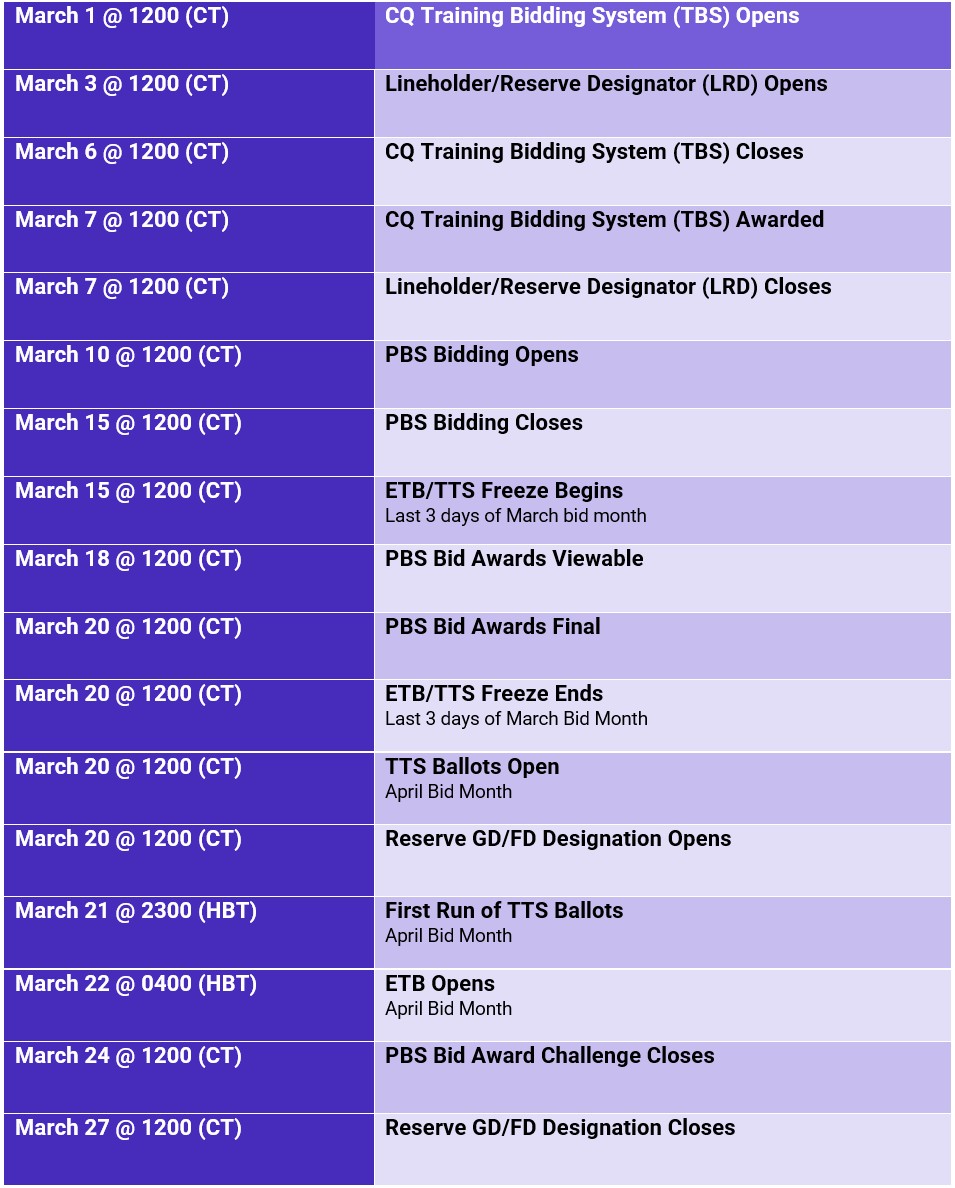
April 2025 Bidding Timelines

- Operational Reliability
- Enhancing UMNR Procedures with MyFlight
- Your Intent, Your Impact
- Data Privacy Training and Privacy Policy Acknowledgement
- Privacy, Risk, and Trust
- Keeping American Secure – Insider Threat
This quarterly training must be completed by Monday, March 17 at 23:59 (CT) to avoid a Missed Assignment (MA).
Please note that starting in April, we will begin implementing boarding pay and sit pay. This change will introduce a new cost for the company. While there are currently no plans to reduce sit times or make other changes, these factors will eventually influence our programming and have an impact. Given the company’s history of finding ways to cut costs, we anticipate there will be adjustments in the future. Although we do not know the specifics of these changes, this is precisely why we included provisions for these items in the new contract.
For those who enjoy metrics, have a keen interest in airports, or are adept at using DECs and Sabre, we encourage you to explore the Ground Event Tracker (GET) site. You can access it by logging into Get.AA.com/GetNG/home with your employee number and password. Once logged in, you’ll see the “New DECs” (we have nicknames for everything in CLT). This platform provides a visual representation of the entire operation, sourcing data from DECs and Sabre. You can view all flights from a specific city, examine the bank schedules, and click on individual flights to access comprehensive details such as tail numbers, maintenance write-ups, planned ground times, the number of bags, gates, passenger counts, crew scan times, door closure times, actual departure times (pay special attention to these two), and even your communications with the agents. There is much more available to explore.
As it’s a new tool, it may take some time to learn how to navigate it, but it is essential for understanding the metrics that are driving our business model. Although there is no formal instruction manual, your Crew Manager should be able to guide you through the basics. This is just another resource to help you adapt to the changes the company is implementing and the new vision they have for the airline.
We apologize for the delay in this month’s allocations report. We received a substantial amount of new information and wanted to ensure you were informed about the upcoming operational changes that will affect our Base.
Take care of yourselves and each other.
The Charlotte APFA Team
In Solidarity,
Scott HazlewoodAPFA CLT Base President
[email protected]
Frank Cagle
APFA CLT Base Vice President
[email protected]

APFA Headquarters
1004 West Euless Boulevard
Euless, Texas 76040
M-F: 9:00AM - 5:00PM (CT)
Phone: (817) 540-0108
Contract & Scheduling Desk
M-Th: 9:00AM - 5:00PM (CT)
Phone: (817) 540-0108
Live Chat Messaging
Fridays: 9:00AM - 5:00PM (CT)
Currently, no scheduled events...
APFA Headquarters
1004 West Euless Boulevard
Euless, Texas 76040
M-F: 9:00AM - 5:00PM (CT)
Phone: (817) 540-0108
Contract & Scheduling Desk
M-Th: 9:00AM - 5:00PM (CT)
Phone: (817) 540-0108
Live Chat Messaging
Fridays: 9:00AM - 5:00PM (CT)
Currently, no scheduled events...
APFA Headquarters
1004 West Euless Boulevard
Euless, Texas 76040
M-F: 9:00AM - 5:00PM (CT)
Phone: (817) 540-0108
Contract & Scheduling Desk
M-Th: 9:00AM - 5:00PM (CT)
Phone: (817) 540-0108
Live Chat Messaging
Fridays: 9:00AM - 5:00PM (CT)
Currently, no scheduled events...