

1.22.26 – APFA CLT Base Brief – 2026-27 Vacation Bidding

2026-27 Vacation Bidding
Thursday, January 22, 2026
It’s that time of year again! Annual vacation bidding starts on Monday, January 26 and concludes with both rounds in March. APFA met with the Company to review the Vacation Matrix. We provided feedback on the distribution of the vacation for the next year. The vacation matrix is driven by the contractual language in CBA Section 8. Here are some of the reminders on how vacation works:
- Vacation is accrued from January 1st (2025) through December 31st (2025)
- We bid vacation January through March in 2 rounds, Primary and secondary.
- Vacation is used from May 2nd (2026) through May 1st (2027) – May 1st is part of the April bid month.
- The number of days you have to bid is based on years of seniority and outlined in the CBA
- Vacation is awarded in seniority order.
- You may bid one block of 1,2, or 3 days. The rest have to be a block of 4 days or more
- A vacation block of 7 days or more will pay and be credited for 4 hours. A vacation block of less than 7 days will be credited for your monthly hours at 3:30 hours but will actually pay 4 hours.
- Vacation must be taken within the vacation year, barring unusual circumstances
- You may bid 20% (No more than 7 days at the max) for filler days. Filler days may be used during the vacation year – (2026-2027) – one month prior and bid must be in by the 8th for the next month. The matrix for the filler days is identical to the primary matrix but is only 5% of the original matrix.
- 2,714 Flight attendants took vacation buyback or 12.1%. CLT was slightly higher than the system average at 12.8%. Pay out for the vacation buyback is in mid June.
- Vacation buyback was awarded to all who bid it and were eligible, they did not limit the vacation buyback
- You may pick up flying over your vacation using the ETB
- Vacation stays with you if you transfer
- If vacation days in the matrix become available due to another flight attendant vacating the position – a leave of absence or rebidding to other days, you may rebid for those days through the Monthly Rebid process
- Days not awarded in the primary round are available to bid in the secondary round, and any days not awarded in both rounds will be assigned
- Vacation trades must be done through the ETB and accomplished by the 5th of the previous month
- If you have 7 or more vacation days, you may add up to 4 VEX days (Vacation Extension Days) to the block of vacation. VEX days may be taken at the beginning or end of the block or split 2 days to each end. You may request these days any time after the award, or 2 months prior to the vacation.
- APFA Vacation Bidding Basics
Your annual vacation summary is available through the Flight Attendant Portal > Monthly Bids > Vacation > Annual > Summary. Be careful when looking at the first screen, make sure you click on the correct bidding year for your summary, the year should be 2026-2027 year. You can also view your accrued sick and vacation days on the Flight Attendant Portal under the FOS screens – Last year SK/VC Accrual (HISK/L).
If you have any questions regarding your accrual or the buyback and bidding process, you may email [email protected] or open a ticket on the Support Tab on Crew Portal.
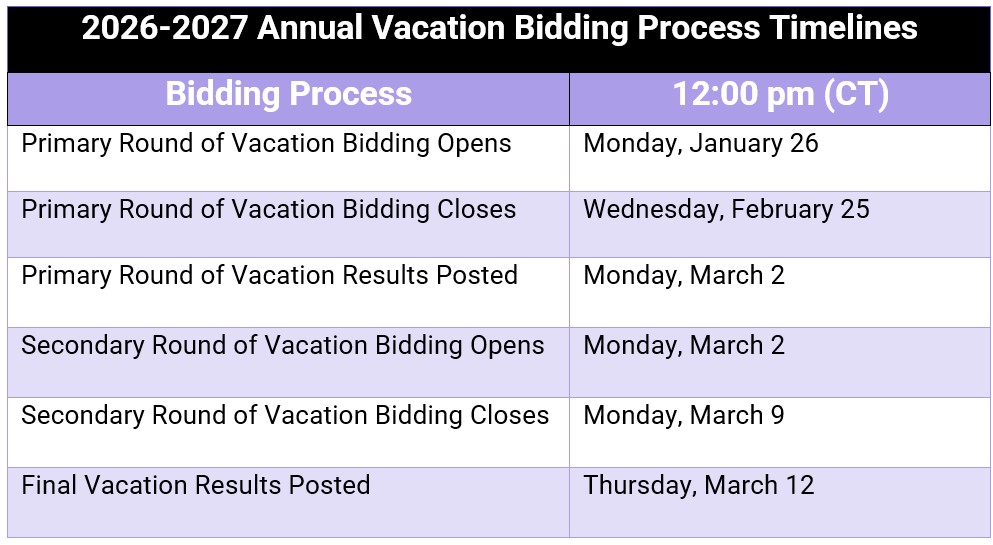
The Matrix is governed by the contract. While the contract states 5.5% of the total vacation will be offered as buyback, the company awarded buyback to anyone who bid for it. 2,714 took the buyback. The buyback days are then removed from the matrix, so the number of days in the matrix are based on the headcount after the buyback days are removed.
Contractually, the company must place a minimum of 3% vacation time in each month except July, August and December must have a minimum of 4.5%. The company did not use the minimum constraints except for July where they placed 4.5% of the vacation time.
The Matrix was a little more balanced than last year as compared to previous years and we see a very similar distribution this year. One of the issues we have advocated for is the “smoothing” of vacation days from month to month. Holidays that fall at the end or beginning of a month put constraints on this, but there are several months that have an even number of days at the end of one month and the beginning of the next month. This is preferred so you can bid for the last few days of one month and the first few days of the next. This allows you to have a block of 7 days, but the vacation is spread into 2 months. It would still credit you 4 hours per day, and you would still have the ability to add VEX days. It also would have reserve advantages. The months where this is possible are Jan-Feb, Feb-Mar, Mar-Apr, Sep-Oct, and Nov-Dec.
What we are very cautious about is a large amount of the vacation being placed in the last part of the year or loaded into a few months. During COVID, they actually placed most of the vacation in the last 3 months (Feb, Mar, April) to save money earlier in the vacation year. When vacation is “loaded” into a few months, it plays havoc with staffing. The more people that have vacation in a month, the more people you need to staff the system. The reserve numbers and the line average are directly affected if there are large amounts of vacation in one month. Summer is the peak flying season and has our largest schedule, it makes sense that there is less vacation available in the summer and during holiday periods. What we advocate for is an even distribution of the vacation throughout the rest of the year.
Here is the breakdown of the vacation percentage per month with a year over year comparison:
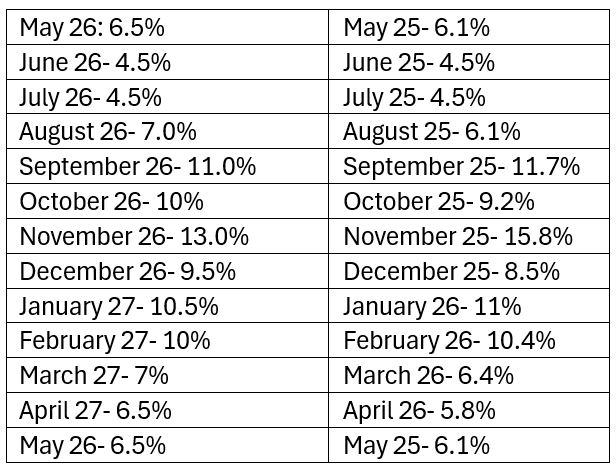
As you can see, not a large shift from the matrix we had last year. We advocated for more vacation days in the summer, particularly, the second half of July and August. The company remains steadfast in keeping vacation days low in the summer, so they are staying with the 4.5% in June and July.
April is unique in that flight attendants will bid days in April just to use them elsewhere in the year for caregiver FMLA. November is usually popular with vacation, but last year people re-bid out of November. The pay incentive for Thanksgiving may have had a lot to do with that. Since the vacation in November went unused, they reduced the total amount for that month and moved it to other months. Only 34% of the total vacation was placed in the back half of the year- Jan to April. The general idea is to have balance and smooth out the vacation wherever possible.
Our schedule of flying has changed over the years, we no longer see a huge increase in flying in May and June, instead we “step up” the hours gradually each month in the spring and ease into summer. The matrix should reflect this with a more balanced distribution in the spring as we increase hours moving into summer. We do see more of that this year. We also see a small pull down to the summer schedule starting in August, the added vacation days also reflect this.
December used to be very low, but we see a pulldown in the first 2 weeks of December. The 9.5% vacation in December is welcome as it is more reflective of the actual schedule.
We advocated for more vacation in June and July, but the company has remained consistent with limiting those months as this is the peak of their schedule.
There is a filler day matrix that will hold 5% of the total vacation time. It is identical to the primary matrix. If you decide to bid for a few days to hold over for bidding later using the monthly rebid process, this is the initial matrix that is used.
The matrix is one of the best we have seen in a few years, we have asked to move some of the days within each month to more weekends and to the natural pulldowns that happen with monthly schedule changes. The matrix is worth looking at when creating your vacation strategy for next year.
Take care of yourselves and each other.
The Charlotte APFA Team
In Solidarity,
Scott Hazlewood
APFA CLT Base President
[email protected]
Frank Cagle
APFA CLT Base Vice President
[email protected]

APFA Headquarters
1004 West Euless Boulevard
Euless, Texas 76040
M-F: 9:00AM - 5:00PM (CT)
Phone: (817) 540-0108
Contract & Scheduling Desk
M-Th: 9:00AM - 5:00PM (CT)
Phone: (817) 540-0108
Live Chat Messaging
Fridays: 9:00AM - 5:00PM (CT)
Currently, no scheduled events...
APFA Headquarters
1004 West Euless Boulevard
Euless, Texas 76040
M-F: 9:00AM - 5:00PM (CT)
Phone: (817) 540-0108
Contract & Scheduling Desk
M-Th: 9:00AM - 5:00PM (CT)
Phone: (817) 540-0108
Live Chat Messaging
Fridays: 9:00AM - 5:00PM (CT)
Currently, no scheduled events...
APFA Headquarters
1004 West Euless Boulevard
Euless, Texas 76040
M-F: 9:00AM - 5:00PM (CT)
Phone: (817) 540-0108
Contract & Scheduling Desk
M-Th: 9:00AM - 5:00PM (CT)
Phone: (817) 540-0108
Live Chat Messaging
Fridays: 9:00AM - 5:00PM (CT)
Currently, no scheduled events...