

7.06.26 – APFA CLT Base Brief – August 2026 Staffing and Allocations
August 2026 Staffing and Allocations
Monday, July 6, 2026
During our monthly staffing review, we discussed the August schedule and the operational changes that will take effect with the August 5 schedule change. This marks the beginning of the annual fall reduction in flying, significantly earlier than in previous years. Last year, the seasonal pullback did not begin until the end of August. As summer leisure travel demand declines, service to seasonal destinations is reduced accordingly.
For August, CLT is scheduled for 209,621 flight hours, down from the July peak of 223,024 hours—a reduction of nearly 14,000 hours. Most of this decrease is reflected in the bank structure. Beginning August 5, CLT will operate eight banks per day, with Sundays operating nine banks. This is the reverse of the pattern we’ve seen in recent years, when the operation typically ran nine banks most days and reduced to eight banks only twice a week. In August, the first four days of the month will see the highest volume of flying, after which Sundays will become the busiest departure days.
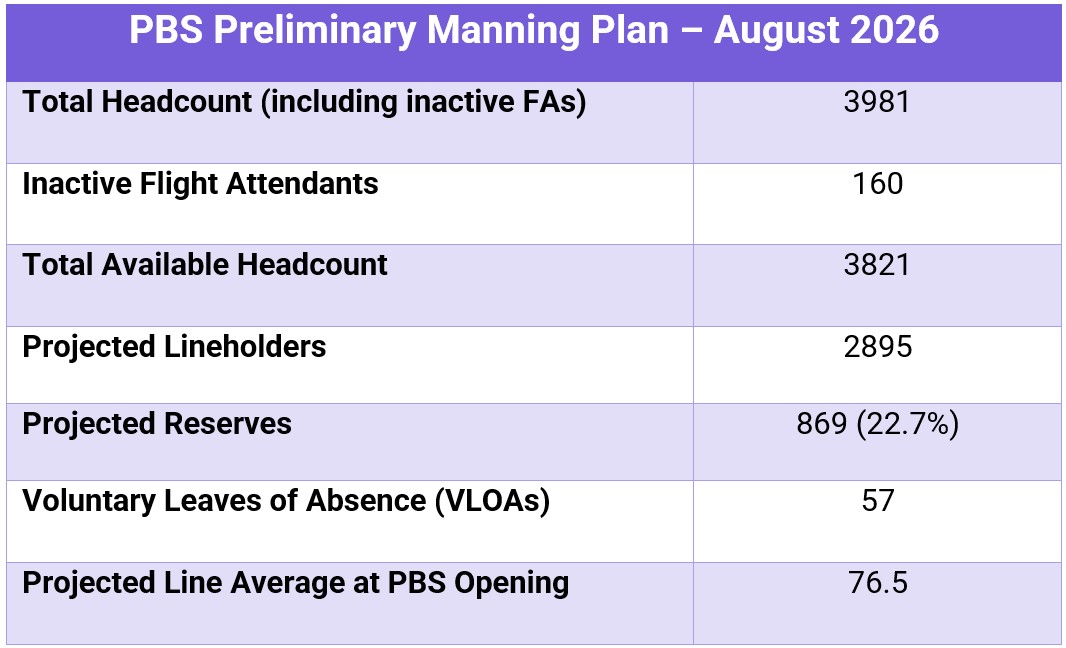
As a result of the reduction in flying, the Company will offer 57 Voluntary Leaves of Absence (VLOAs) for August. Line averages have also decreased, and the number of Reserve positions has been reduced. The projected Reserve rotation cutoff will be April 4, 2024, although tentative Reserve numbers may fluctuate depending on the number of Flight Attendants awarded VLOAs. Historically, there has been strong interest in VLOAs, and we have not experienced difficulty filling the available positions.
There are no new-hire classes joining the operation, as seasonal hiring has concluded. As we move beyond the Labor Day holiday on September 7, we anticipate additional seasonal schedule reductions. With those reductions, we also expect the Company to offer additional Voluntary Leaves of Absence (VLOAs) during the fall months.
Reserve staffing remains higher than operational demand would suggest. Although the base is scheduled to fly fewer hours than it did in May, Reserve headcount is actually higher. Last year’s utilization does not support these elevated Reserve numbers. Instead, they reflect how fragile the current operation has become. The Company continues to rely on an inflated Reserve pool to recover the schedule when disruptions occur, while the large number of system trips built each day highlights the operational challenges facing the network.
Trip Breakdown
One-Day Trips – Nearly 24% of all sequences
- The Company continues to emphasize one-day flying.
- As seasonal leisure flying declines, more four-leg one-day sequences are being built.
- There are also more late-arriving turns that operate as one duty period spanning two calendar days. These sequences may also populate the ODAN fields.
Two-Day Trips – Nearly 19% of all sequences
- Slightly lower than July, while continuing to provide a healthy mix of departure times.
Two/Three-Day Trips – 11% of all sequences
- Down from July.
Three-Day Trips – 29% of all sequences
- A slight decrease from July, although the international (IPD) schedule continues to operate at full strength.
- These remain the “workhorse” trips of the operation, typically featuring the greatest number of flight legs and the longest duty periods.
Three/Four-Day Trips – 2% of all sequences
- Slight increase from July.
Four-Day Trips – 3% of all sequences
- Slight increase from July.
ODANs – 6.7% of all sequences
- The current bank structure continues to reduce the number of ODAN opportunities.
- Later departure times limit the Company’s ability to build these pairings.
- This is the lowest ODAN percentage since the winter schedule in January and February.
Red-Eye Flying – Approximately 2% of all sequences
- Seasonal schedule reductions continue to reduce West Coast flying.
- Most Red-Eye pairings continue to “step out” to the West Coast rather than operate as a full turn on the first day.
Pink Eyes and Bullets
- These remain a very small portion of the overall schedule, with only a handful of pairings available.
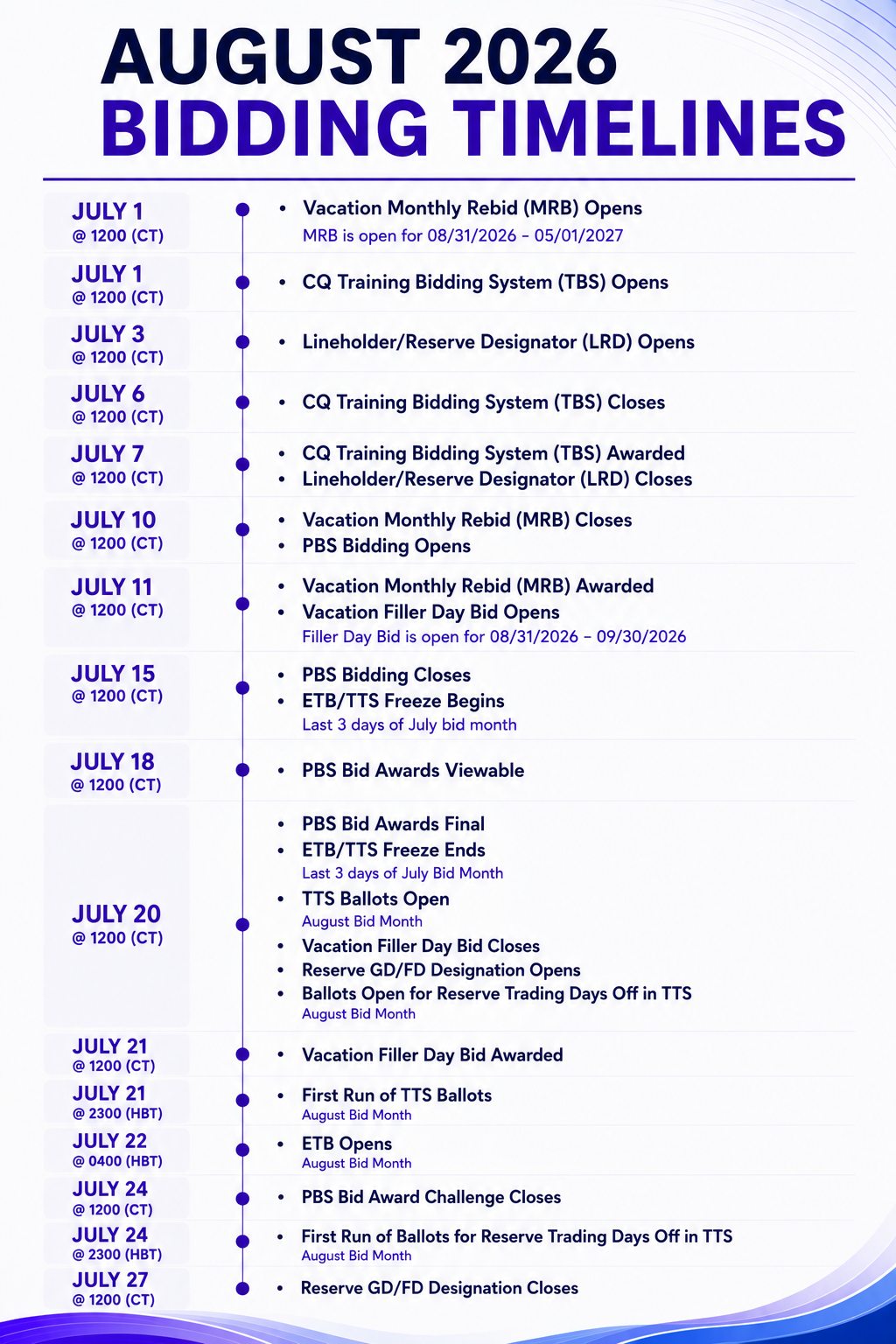
August marks the beginning of the fall schedule pullback, with trip construction remaining largely consistent with what we’ve seen in recent bid months. One encouraging trend is the continued effort to better manage the number of 3-day trips while placing greater emphasis on building more 1-day sequences.
As we transition from the peak summer schedule into the fall, the reduced flying and staffing levels provide the company with greater flexibility to adjust the trip construction model. APFA will continue advocating for improvements that enhance quality of life, and we are encouraged by the continued movement away from 3-day pairings in favor of additional 1-day and 2-day trips.
Take care of yourselves and each other.
The Charlotte APFA Team
In Solidarity,
Scott Hazlewood
APFA CLT Base President
[email protected]
Frank Cagle
APFA CLT Base Vice President
[email protected]
APFA CLT: (704) 665-7474

APFA Headquarters
1004 West Euless Boulevard
Euless, Texas 76040
M-F: 9:00AM - 5:00PM (CT)
Phone: (817) 540-0108
Contract & Scheduling Desk
M-Th: 9:00AM - 5:00PM (CT)
Phone: (817) 540-0108
Live Chat Messaging
Fridays: 9:00AM - 5:00PM (CT)
Currently, no scheduled events...