

7.09.25 – Treasurer’s Update/Annual LM-2 Filing Now Available Online
Wednesday, July 9, 2025
We’ve officially posted the LM-2 report for the fiscal year ending March 31, 2025, in the Members-only section of the APFA website. This required filing with the U.S. Department of Labor provides a detailed accounting of how your dues were received, allocated, and disbursed.
To help put the numbers in context, we’ve included an overview of this year’s performance, a five-year financial trend analysis, and a breakdown of how our budgeting strategy continues to evolve. We also explain how reimbursements, external legal fees, and the use of Special Activity Funds and the Negotiations and Negotiations Related Fund (NNRF) all impact what appears in the LM-2.
This update is part of our ongoing commitment to transparency and responsible financial stewardship on behalf of all APFA Members.
What is the Negotiations and Negotiations Related Fund (NNRF)?
The NNRF contains funds restricted by the APFA Investment Policy for contract negotiations and negotiations related expenses (non-operational use).
Annual LM-2 Filing: What It Means
The LM-2 is a federally required annual financial report that must be filed by all labor Unions under the U.S. Department of Labor’s Office of Labor-Management Standards (OLMS).
It provides a detailed accounting of:
- Total receipts and disbursements.
- Compensation paid to Union Representatives and Staff.
- Payments made to outside professionals, vendors, and consultants.
- Assets, liabilities, and any related trusts or benefit plans.
Unions like APFA are legally required to file this report each year to demonstrate compliance with federal financial transparency laws. For APFA members, the LM-2 is an opportunity to see exactly how your dues are being used and what it takes to run a strong Union.
Where Your Dues Go
Members contribute $41/month in dues. That breaks down to:
- $37 – Union operations: Representation, legal, education, enforcement, events, elections, etc.
- $4 – Reserved for the NNRF: Funds restricted by the APFA Investment Policy for contract negotiations and negotiations related expenses (non-operational use).
Even with consistent growth in expenses and services, we’ve stayed under budget every year since this administration took office.
Changing How We Budget for the Future
In 2022, we made a strategic shift in how we handle unpredictable expenses like meetings & events, arbitrations, elections, and litigation. Instead of “guess-budgeting” based on projected need, we established dedicated Special Activity Funds, structured like the NNRF, and began funding them annually at fixed levels.
This structure gives us the ability to build resources over time while maintaining consistency in Member services.
Special Purpose Fund Activity Snapshot (FY2022–FY2026 YTD)
click image to enlarge
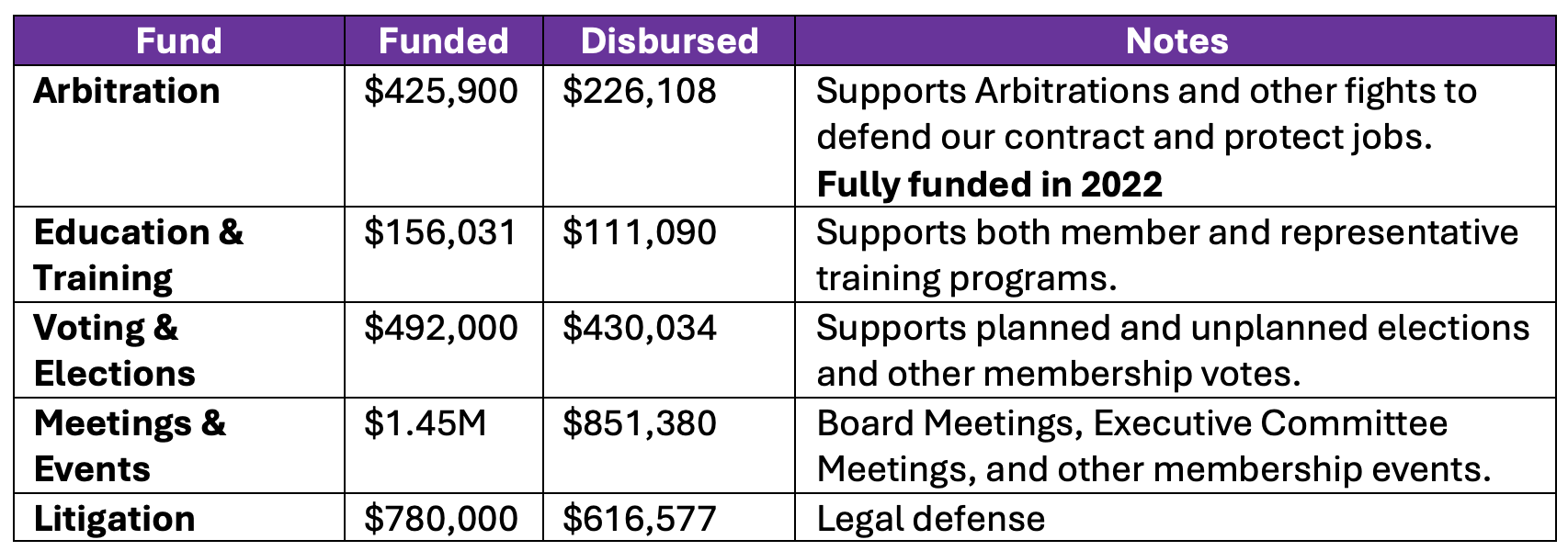
All disbursed amounts are reimbursed to the general budget, meaning they do not negatively impact our profit & loss.
Membership Growth
APFA’s total membership has increased by almost 16% in just five years, growing from 24,848 active Members in FY2021 to 28,732 in FY2025. This growth reflects both American Airlines’ hiring surge post-COVID and our Union’s ongoing efforts to engage and retain Members across all bases.
More Members mean more dues, but also more services, support, and representation needs. We’ve invested in better technology, training, and legal resources to meet that demand head-on.
Asset Performance
While the LM-2 shows total disbursements each year, it doesn’t reflect the reimbursements that APFA receives from our “Special Activity” funds. Here’s what’s really happening behind the numbers:
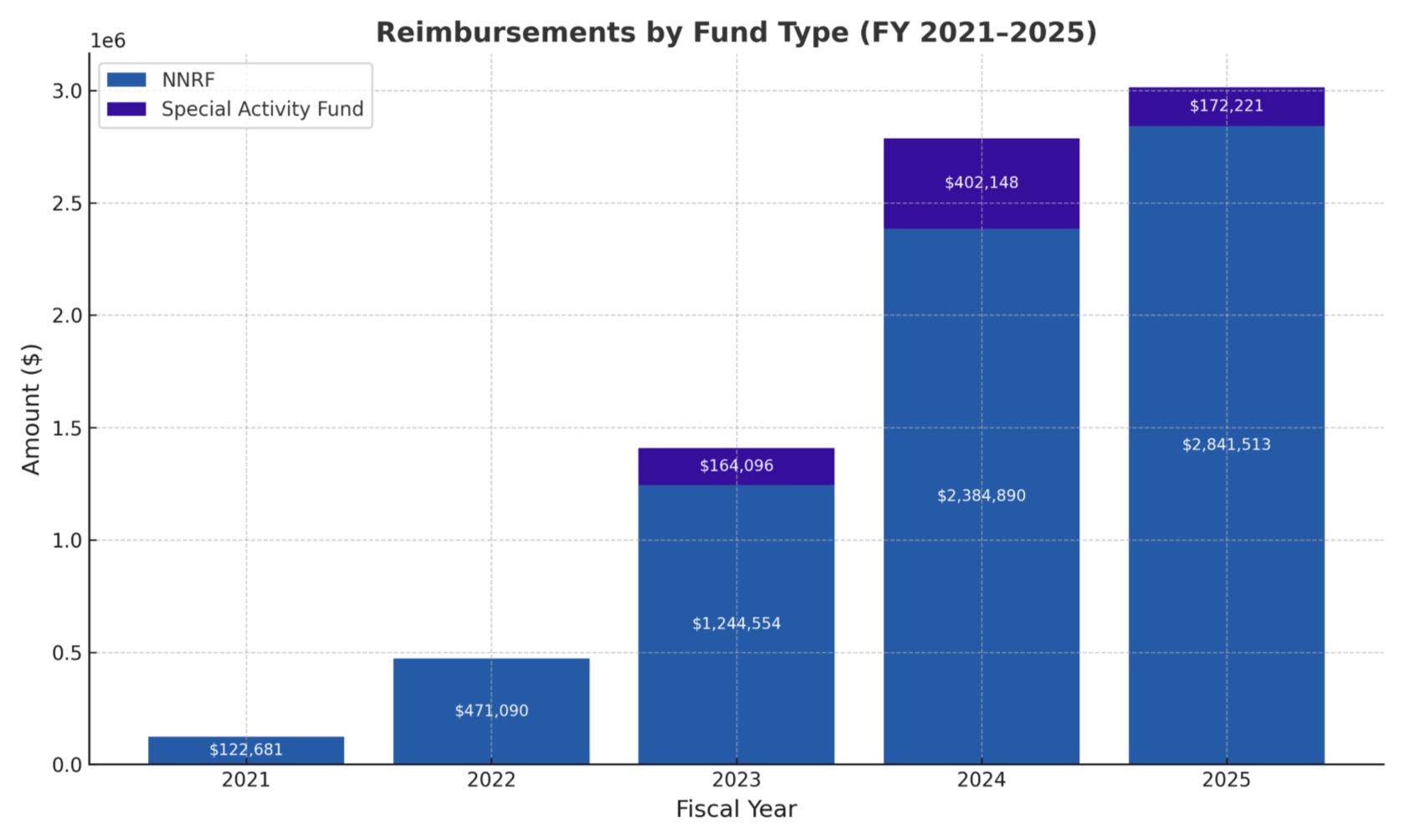
- In Fiscal Year (FY) 2025, we disbursed $3,013,734 that was reimbursed from our restricted and non-restricted investment accounts.
- Of this, $2,841,513 came directly from the Negotiations and Negotiations-Related Fund (NNRF), while the remaining $172,221 came from our Special Activity Funds.
- Because those reimbursements come from investment accounts, they appear as asset reductions even though they directly covered essential services.
- We are spending more of our own money to represent, organize, educate, and protect Members, not sitting on cash or letting dues sit unused.
Reimbursements by Fund Type (FY 2021–2025)
This chart distinguishes reimbursements received from the NNRF and those from our non-restricted Special Activity Funds.
click image to enlarge
NNRF and Special Activity Funds Investment Accounts: Key Differences
While both are housed in our investment accounts, the NNRF is made up of multiple restricted accounts solely reserved for contract negotiations and cannot be used for day-to-day operations. The Special Activity Funds are housed in our non-restricted investment account.
Revenue: What We Collected vs. Budgeted
Each year, we see a gap between budgeted income and what we actually collect. This is largely due to Members on leave, not flying enough hours, or in non-pay status, which directly impacts monthly dues collection.While arrears recovery has helped, mostly from dues that accumulated since the early 2000s, it’s retroactive and inconsistent. Arrears recovery helps bridge the gap between our budgeted income and our dues income, but doesn’t fully close it.
click image to enlarge
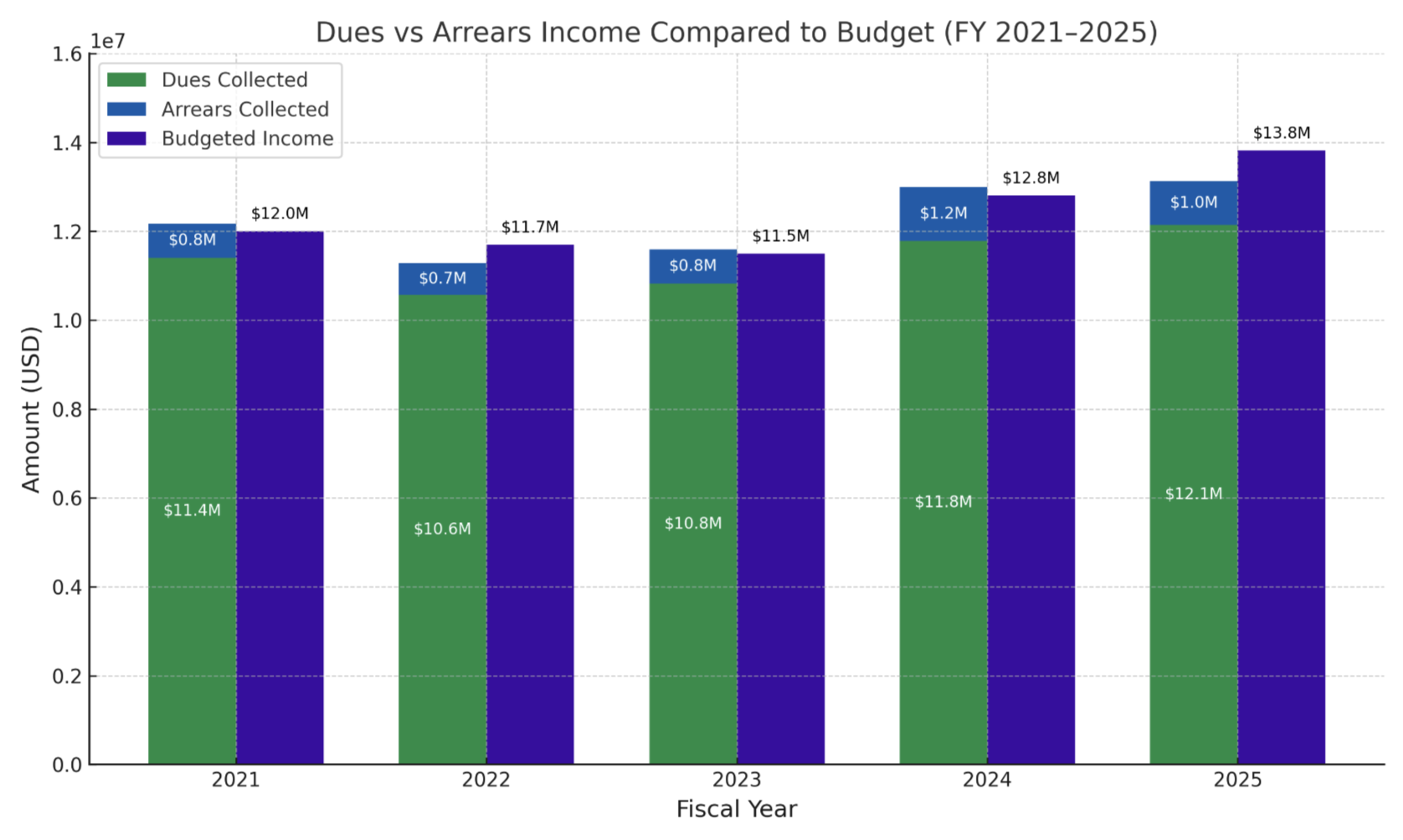
Dues Arrears Recovery/ Arrears Collected Since FY2022Since Fiscal Year 2022, APFA has recovered a large majority of the unpaid dues balance thanks to stronger financial accountability measures, expanded Member outreach, and systems designed to flag issues before they threaten good standing. As of March 2022, our dues arrears balance was $2,983,410.10.
Here’s the arrears collection break down by year:
- FY2022: $219,323.67
- FY2023: $318,606.22
- FY2024: $1,217,113.95
- FY2025: $998,982.22
Total Arrears Collected Since FY2022: $2,747,026.06
Alert Letters & Payment Arrangements
Since September 2022, APFA has issued 1,992 alert letters to 1,707 Members, representing $921,835.50 in outstanding dues balances.
The purpose of these letters isn’t punitive. They’re a required first step under Section 35.F. of the CBA, designed to notify members of delinquency and offer options before any employment risk arises.
As a result:
- 239 Members opted into our Payment Arrangement Program, launched in June 2023 by the Board of Directors.
- These 239 members alone have repaid $343,549.79 in arrears.
Dues Hardship Forgiveness
Dues Hardship Forgiveness is a program designed to assist Members experiencing serious financial hardship due to medical emergencies, caregiving responsibilities, or other unexpected life events. Since 2021, 133 Members have requested and been considered for Dues Hardship Forgiveness.
Spending
While we’ve maintained a sustainable financial position over the past five years, the reality is that the cost of doing business, and doing it well, has continued to rise.
Over the past two years alone:
- Fixed operational costs have increased between 4% and 12% annually, driven by inflation, technology, legal complexities, and vendor pricing.
- In October, we reached a Tentative Agreement with our Staff Union, reflecting increased payroll costs.
- The historic CBA ratified in September 2024 increased representative pay and removal costs by 18–20%.
National Officer Compensation
The 2025 LM-2 also shows a significant increase in gross salary disbursements to the four National Officers. This is the result of two major CBA-related changes and profit sharing:
1. 20% Wage Increase Secured in the New CBA National Officers receive the same hourly rate, vacation accrual, and benefits as line Flight Attendants, nothing more, nothing less. Policy Manual 6.A.
2. Retroactive Pay Processed in FY2025 (reimbursed from the NNRF) per Policy Manual Section 6.B.4. Just like our Members, National Officers received retro pay from the new CBA, which increased their reported compensation for this year only.
3. Profit Sharing As part of the profit-sharing formula, National Officers also received a payout in 2025, just like every other Flight Attendant. Policy Manual 6.B.5.
📌 Officer compensation is determined by Section 6 of the APFA Policy Manual and not determined by the Officers themselves.
Defending the Union: Legal Costs and Strategy
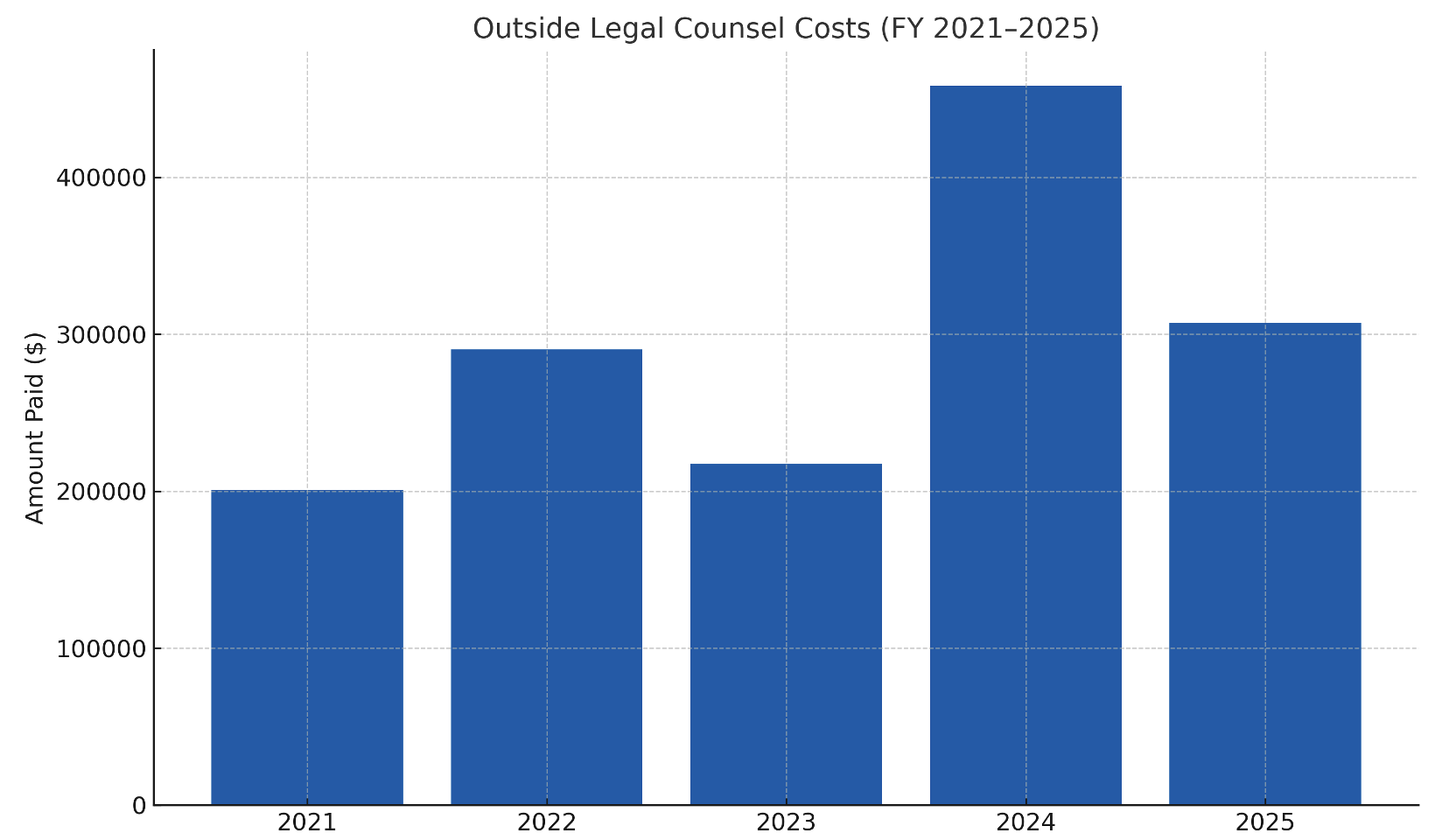
From FY 2021 to FY 2025, APFA spent $2,191,104 on outside legal counsel, not to defend you against corporate greed or attacks on our safety and careers, but to defend your Union against lawsuits and attacks, many of which were filed by former Officers or Members unhappy with election results.
In 2022, we established an in-house Legal Department, which has significantly reduced the need for outside legal services while allowing us to focus on contract enforcement, Member advocacy, and strengthening our negotiation capabilities.
Outside Legal Counsel Costs (FY 2021–2025)
This chart shows the total spent on external law firms. These expenses would have been higher had we not created an in-house legal department in 2022.
click image to enlarge
📌 Important Note: APFA’s Legal Department represents the Union as an entity. It does not provide personal legal counsel to individual Members or Officers of the Union.
Full Transparency & Member Access
Our steady hand has helped APFA survive and adapt through one of the most complex periods in airline history. But we’re also facing growing demands and rising costs. These are signs of strength, but they also limit our ability to grow and modernize.
As always, Union financial and administrative records are available for Member review under Section 7.G.1 of the APFA Policy Manual. Appointments to view these records may be made by contacting the National Treasurer’s Department.
In Solidarity,
Erik Harris
APFA National Treasurer
[email protected]

APFA Headquarters
1004 West Euless Boulevard
Euless, Texas 76040
M-F: 9:00AM - 5:00PM (CT)
Phone: (817) 540-0108
Contract & Scheduling Desk
M-Th: 9:00AM - 5:00PM (CT)
Phone: (817) 540-0108
Live Chat Messaging
Fridays: 9:00AM - 5:00PM (CT)
Currently, no scheduled events...