

7.21.26 – The Operational Cost of AA’s Micromanagement
Tuesday, July 21, 2026
The Operational Cost of AA’s Micromanagement
For more than 30,000 Flight Attendants across American Airlines, a troubling pattern has emerged.
Since the June 2025 systemwide inflight management restructuring implemented by Vice President of Inflight Bobbi Wells, Flight Attendants have experienced an unprecedented increase in mandatory meetings, investigations, and removals from flying. While every company has the right to manage its employees, there is a difference between leadership and micromanagement. What was introduced as a restructuring intended to improve support has become a structure whereby Flight Attendants are now considered guilty until they prove themselves innocent.
No one is arguing that accountability should not exist. When legitimate performance issues arise, they should be addressed fairly and professionally. But somewhere along the way, common sense has been replaced by a toxic culture where too many routine matters are treated as investigations rather than opportunities for clarification, engagement, or support.
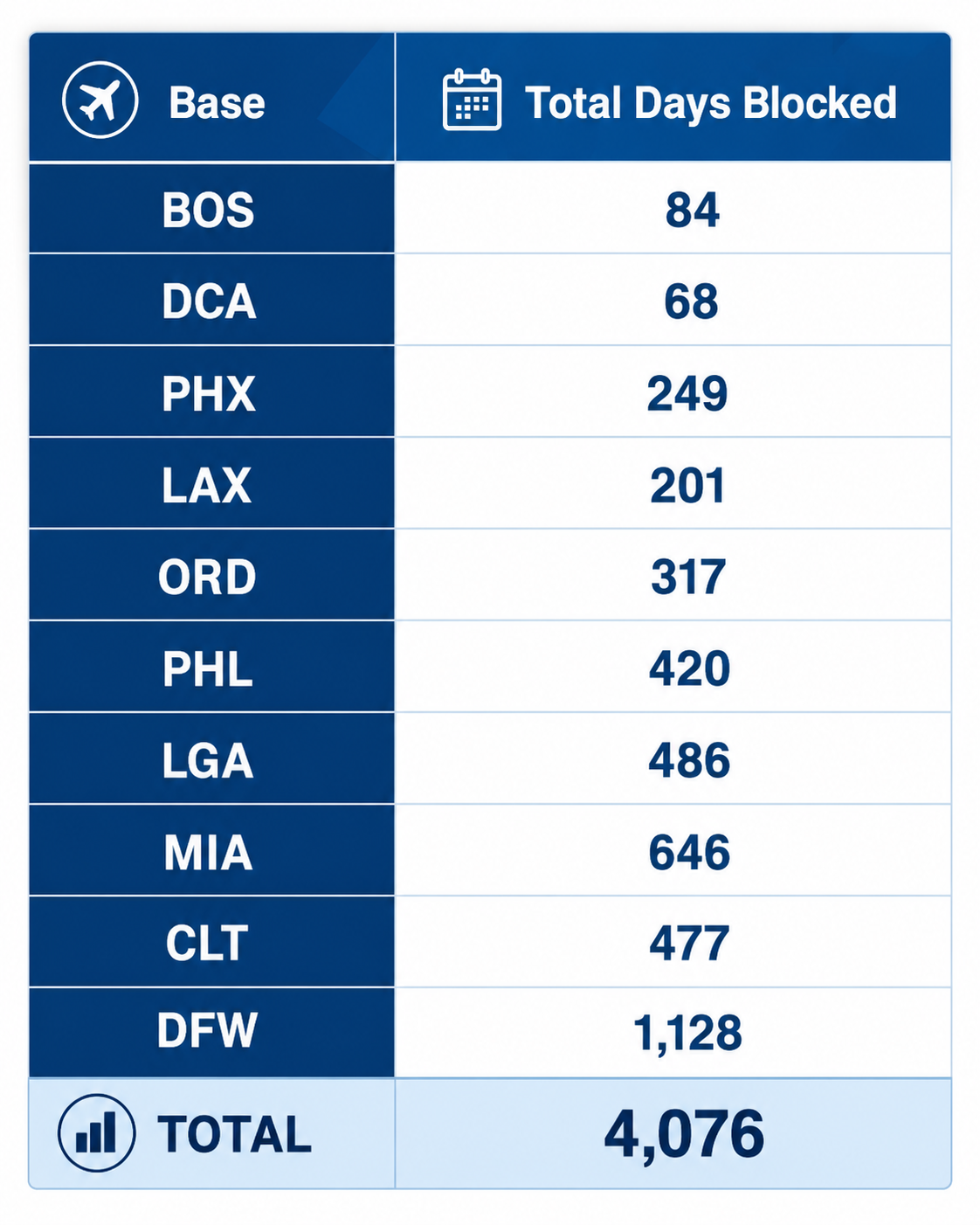
Across the system, Flight Attendants are being removed from scheduled trips and reserve days at an alarming rate to attend mandatory meetings. During the June 2026 contractual month alone, the company blocked Flight Attendants from flying for 4,076 days. That represents 4,076 days that Flight Attendants were taken off the line.
Total Days Blocked by Management for June 2026
Every removal creates additional vacancies and affects every one of us through:
- Increased reserve utilization,
- Increased 3% TTS restrictions and denials,
- Increased rescheduling, and
- A reduction in scheduling flexibility.
The result is a less efficient operation, greater strain on our crews, and a diminished customer experience. Every unnecessary removal creates a vacancy that disrupts staffing and weakens the operational reliability American strives to deliver. Without adequate crew coverage, avoidable disruptions become unavoidable, affecting the operation and, ultimately, the passengers who depend on us to get them safely and reliably to their destinations.
Many meetings now center on vague passenger survey comments, anonymous allegations with no specific facts, or issues for which Flight Attendants have already provided clear documentation. APFA has represented Members removed from high-paying trips for twenty-minute meetings to document a stolen Electronic Flight Bag (EFB), called into meetings after emergency hospital visits, required to answer anonymous complaints lacking any corroborating evidence despite decades of exemplary service, questioned after simply following company policy, and investigated after security incidents or passenger assaults.
These are not isolated frustrations—they are symptoms of a management that is diverting valuable time and company resources away from supporting Flight Attendants and Customers.
We want to hear from you…
In the coming weeks, APFA will launch a brief systemwide survey to measure the impact of these excessive meetings and removals on Flight Attendants, our operation, and Members’ confidence in the inflight changes implemented by Vice President of Inflight Bobbi Wells. If the company won’t ask Flight Attendants whether these changes are working, APFA will. We will collect the data, document the impact, and present the results directly to upper management.
Flight Attendants are being held accountable for delays, operational failures, and service failures they neither caused nor controlled. It is time management is held accountable for the impact of its own decisions. Flight Attendants deserve leadership that supports them—not a system that removes them from the line to micromanage them.
In Solidarity,
APFA Headquarters
1004 West Euless Boulevard
Euless, Texas 76040
M-F: 9:00AM - 5:00PM (CT)
Phone: (817) 540-0108
Contract & Scheduling Desk
M-Th: 9:00AM - 5:00PM (CT)
Phone: (817) 540-0108
Live Chat Messaging
Fridays: 9:00AM - 5:00PM (CT)
Currently, no scheduled events...