

Safety & Security
Contact Information
 Andrew Rhinehart - Safety & Security Chair
[email protected]
Office: (817) 540-0108 ext. 5870
Base Representative Contacts
APFA Notification System
APFA NS Privacy Policy
Critical Incidents: 817-357-8786
Call IOS when:
— Sick on layover
— Crew member isn’t present for pickup
— Clearance to print off IFM info when tablet is lost or missing
— Emergency support is needed when flight deck is not onboard
— During emergencies that may arise while on layover
MOD can be useful for a multitude of situations while at the gate in a hub. AA IOC MOD: (682) 315-8000
|
BOS CLT DCA DFW LAX LGA |
JFK MIA ORD PHL PHX |
APFA Notification System for Critical Incidents
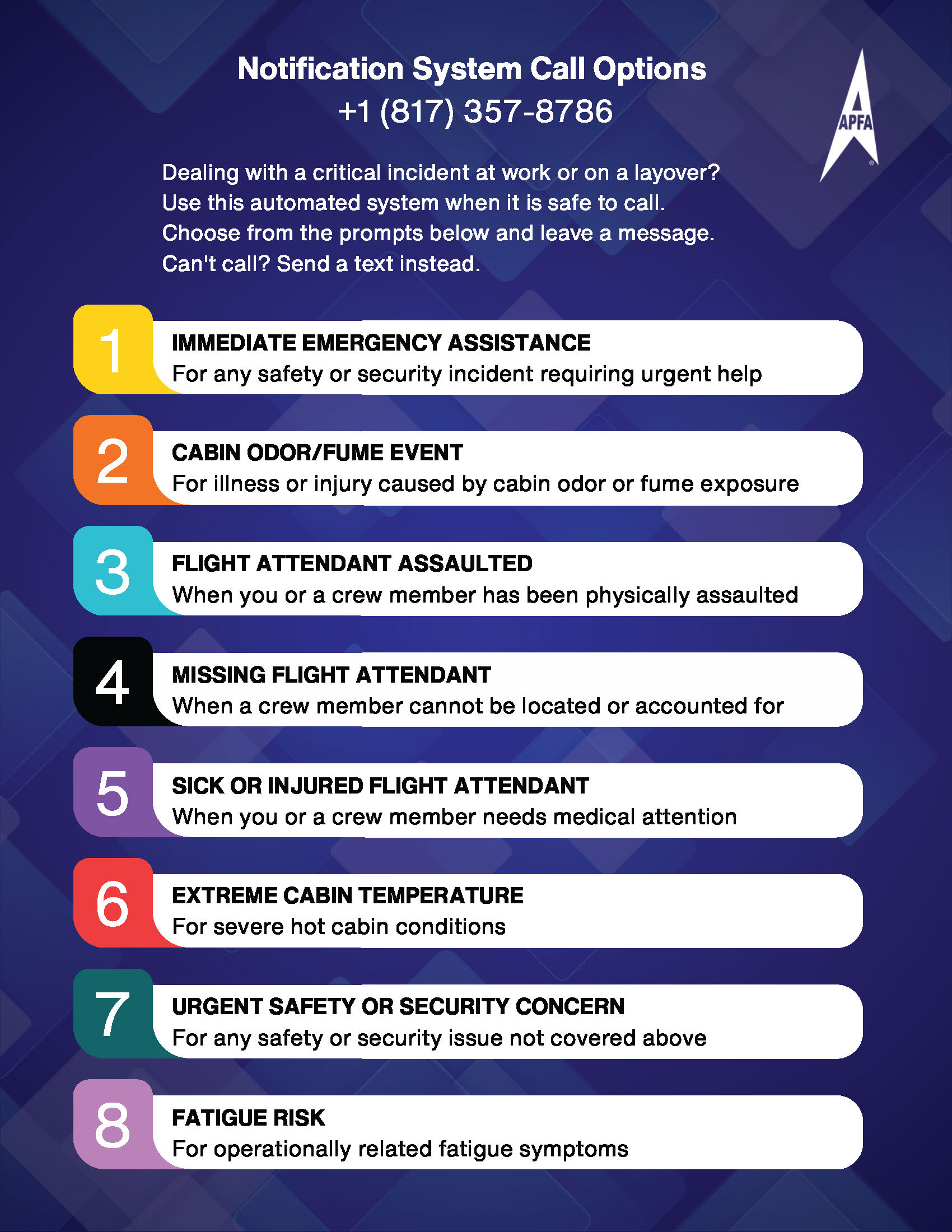
Incidents Checklists
View or Download the checklist below corresponding to a critical incident during a flight or while on a layover. These checklists will provide more information on what to do and who to contact for further assistance.
Additional On-Duty Checklists
View or Download a checklist if you encounter an incident during a flight or while on a layover with Law Enforcement/Government Officials or need Deportee Passenger Procedure Information. These checklists will provide more information on what to do and who to contact for further assistance.
Safety & Security Hotlines
7.11.26 – Earlier Descent Procedures Are About One Thing: Safety
One month has passed since the implementation of the revised descent procedures, and we wanted to take a moment to revisit why these changes were made and why they remain so important. These procedures were not created simply to change the way we work.
7.10.26 – CMAP Expands to DFW and ORD on July 12th
The Transportation Security Administration’s (TSA) Crewmember Access Point (CMAP) program will continue its phased rollout beginning the week of July 12th, with DFW and ORD joining the growing list of participating airports.
6.23.26 – CMAP Opt-In Now Available
The Transportation Security Administration’s new Crewmember Access Point (CMAP) program continues its phased rollout as the eventual replacement for the Known Crewmember (KCM) program. Flight Attendants who wish to participate may now voluntarily opt in
6.12.26 – TSA’s New Crewmember Access Point (CMAP) Program Coming Soon
The Transportation Security Administration (TSA) is preparing to launch the next evolution of the Known Crewmember (KCM) program through a new platform called the Crewmember Access Point (CMAP).
6.10.26 – 2025-2026 CQ Module Length Presidential Grievance
APFA has continued to push the Company for a remedy regarding the CQ Module Presidential Grievance. As part of the contractual process, we conducted our pre-arbitration conference with the Company.
6.01.26 – APFA Secures Improvements to the 2026-2027 CQ Program
Monday, June 1, 2026 APFA Secures Improvements to the 2026-2027 CQ Program American Airlines Inflight management has imposed changes to the 2026-2027 Flight Attendant Continuing Qualification (CQ) program. These changes…
5.29.26 – Earlier Descent Procedures Beginning June 3rd
This week, Inflight management announced that it will implement revised descent procedures intended to reduce turbulence-related injuries and improve communication between the flight deck and cabin crew.
One month has passed since the implementation of the revised descent procedures, and we wanted to take a moment to revisit why these changes were made and why they remain so important. These procedures were not created simply to change the way we work.
The Transportation Security Administration’s (TSA) Crewmember Access Point (CMAP) program will continue its phased rollout beginning the week of July 12th, with DFW and ORD joining the growing list of participating airports.
The Transportation Security Administration’s new Crewmember Access Point (CMAP) program continues its phased rollout as the eventual replacement for the Known Crewmember (KCM) program. Flight Attendants who wish to participate may now voluntarily opt in
Town Halls
Reporting
Cabin Air Quality
If you are currently experiencing symptoms: headache, bloody nose, chest tightness, profound fatigue, muscle aches, elevated blood pressure, sinus congestion and/or a persistent cough.
1. Contact the Inflight Operations Support Desk at IOC at 1-682-315-7070
- Inform them that you are experiencing smoke, odor, fume symptoms or injury along with the Flight # and where the event occurred.
- You will also inform them of your need to seek necessary and immediate medical treatment at the nearest hospital (not urgent care) for proper testing of possible exposure with their assistance.
2. Call APFA Notification system phone number: 817-357-8786 and choose prompt #2 (Cabin Odor/Fume Event)
3. When arriving to the hospital advise the nurses at check-in that you need to be seen immediately because you have been exposed to fumes and need to have your blood tested for Carbon Monoxide exposure, and there is only a four-hour window to detect this type of exposure.
4. After arriving at the hospital, you may contact MedAire for exposure to SOF events by calling 1-877-346-9174 / 1-480-333-3801 for additional assistance at the hospital if you are having issues being seen right away.
5. You must file an IOD 1-844-777-8463 or click here to review the APFA IOD Packet to see how to file and IOD.
6. Document the event with a CERS Report under the topic of ‘Fire/Smoke/Fumes/Odor’ and with a Cabin ASAP Report under ‘General or Specific Cabin Safety Concern > Fire/ Smoke/ Odor.’
If you need further assistance, you may speak with the Safety and Security Rep on Duty at 817-540-0108 EXT 1,4,1,1 or [email protected] or speak with an EAP rep at 833-214-2002 or [email protected]
For questions about pay, sick time, personal days, or further support please reach out to your local base leadership. Their contact information may be found on the Bases Page, or you may use the Base Contact Form on the APFA website.
Download the SOF Event checklist and View the SOF Response Flowchart PDF
Read more about Smoke, Odor, & Fume events or file a Smoke, Odor, Fume Event Report with APFA
Safety at American Airlines
Reporting
Reporting is the primary method of driving change within the company. Through reporting, trending hazards are identified and working groups come together (including APFA) to determine mitigations for those hazards. CERS and Cabin ASAP reports are the two most used methods of reporting for Flight Attendants.
Safety Management Systems (SMS) at AA
Safety Management Systems (SMS) is the method the company employs to managing safety risks. There are four pillars of SMS:
Safety Policy – Senior management’s commitment to the continuous improvement of safety.
Safety Risk Management – The process of identifying and controlling risks.
Safety Assurance – Evaluates whether the implemented controls are effective.
Safety Promotion - Advocates for positive engagement in safety culture with all workgroups.

Just Culture™
Just Culture fosters trust in reporting systems so that employees feel empowered to report things. It is anchored in a learning culture instead of a blaming culture. It ensures that employees are treated fairly if they make an error or at-risk choice. Cabin ASAP uses Just Culture when investigating reports.
Cabin ASAP
What is Cabin ASAP?
The American Airlines Cabin Aviation Safety Action Program (Cabin ASAP) is designed for Flight Attendants to report and the Company to identify and correct specific safety issues at American Airlines. The program provides a voluntary, cooperative, and non-punitive environment for the open self-reporting of cabin safety concerns. Through such reporting, valuable information is learned that may not otherwise be obtainable.
Objective
The objective of the Cabin ASAP Program is to promote safety. How we accomplish this objective is by identifying cabin safety concerns. Learning what Flight Attendants experience out on the line is the best tool for improving safety.
Cabin ASAP promotes safety through the following essential steps:
-
- Identifying hazards (most critical)
- Analyzing risks
- Accomplishing corrective solutions
- Validating and verifying effectiveness
- Educating and increasing employee awareness
- Measuring overall system performance
- Ensuring a continuing system of accountability
APFA encourages Flight Attendants to submit all safety concerns into the ASAP Program. The more data that is gathered, the more systemic issues can be identified and fixed.
Reports are confidential and may not be discussed or shared with any members outside of the ASAP Event Review Committee (ERC). If needed, the ERC may decide to share a de-identified report outside of ASAP to further investigate the safety concern or for information gathering. The ERC may also elect to contact a submitter for further information. An APFA ASAP ERC member will make these contacts. Contact with a submitter over the phone or in person is considered an extension of the ASAP report and all confidentiality rules will apply. Additionally, the APFA ERC member may request more information from a submitter to share with the rest of the ERC. The ASAP ERC is composed of three members: An APFA ASAP Representative, an FAA Inspector, and a representative from American Airline’s Safety Department.
Flight Service is not involved in the ASAP process. All ASAP reports are confidential, and once submitted, the report remains within the ASAP program.
CERS
When you submit a CERS report, it is sent to Daily Ops for processing. The information is then compiled and sent to various people across several departments including but not limited to your FSM and APFA Safety & Security.
For assistance completing a CERS report, call the MOD at your base.
Reasons to File a CERS:
-
- Any event or hazard that would need to be brought to the company’s attention to strengthen inflight safety, security, operations, as well as policies and procedures.
- Emergency landing
- Turbulence, whether it be light, moderate, severe, or there’s a reported injury
- Medical Emergency, including the use of medical equipment as well as if any contact was made to bodily fluids or infectious disease
- Passenger and crew member illness/injury
- If any emergency equipment isn’t present onboard during equipment checks
- Decompression
- Security related event, or security concern with passenger
- Passenger misconduct
- Inadvertent Slide Deployment
- Hot Cabin (with ASAP) or Cabin Cleanliness issue
- Operational issues: UMs, boarding issues, suspected human trafficking, hotel transportation issues to and from the airport for layovers
- Events occurring while on layover that need to be brought to the attention of the company
Fatigue
Fatigue Process and Reporting
Cabin LOSA
FAR Quick Reference
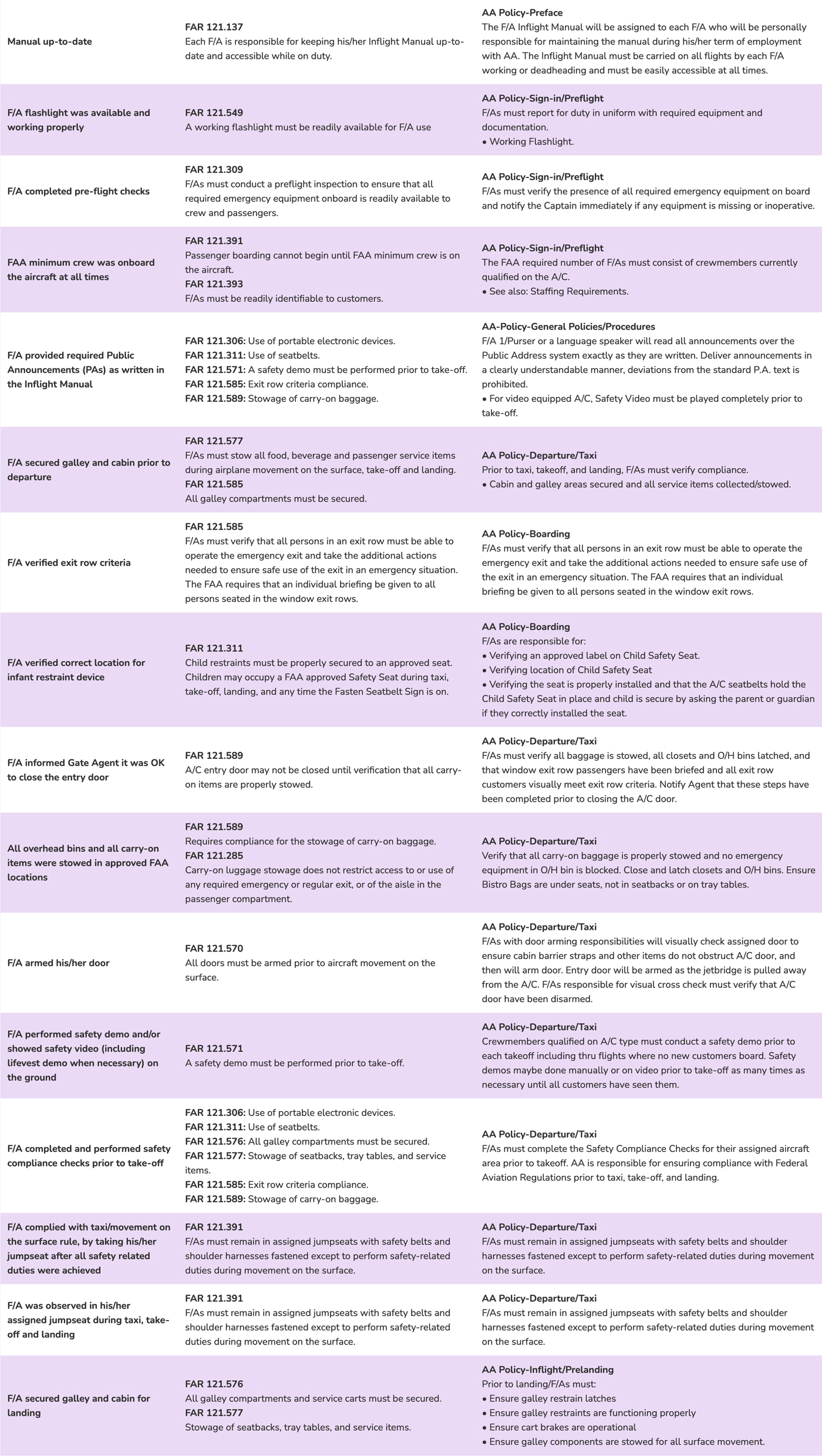
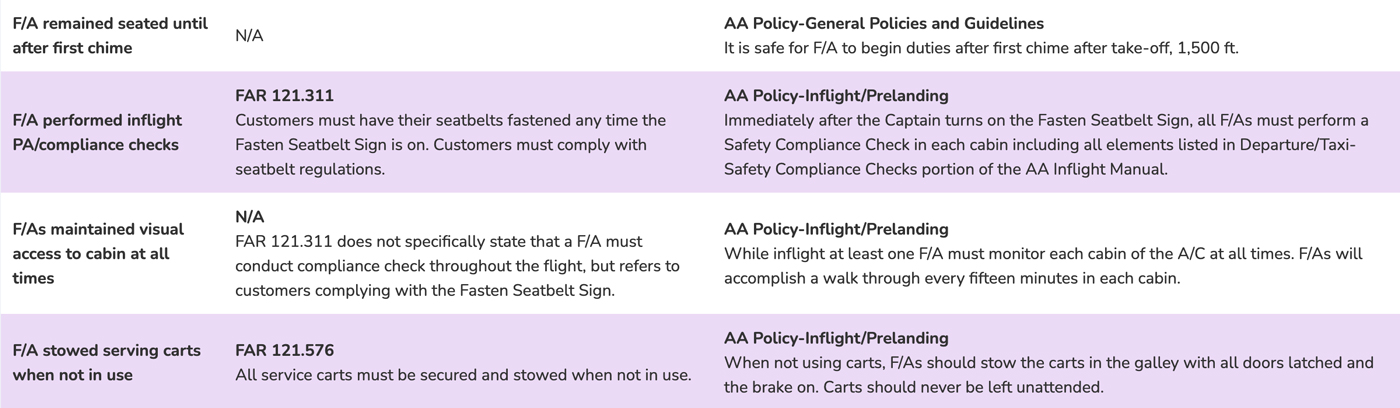

Flight Attendant Policies & Procedures
Minimum Crew
Minimum crew violations continue to rise, and these violations usually result in punitive action taken against Flight Attendants. Fines may also be levied against American. If you are involved in a minimum crew violation, always remember to file an ASAP report immediately and contact your base representative.
Communication between Flight Attendants and agents is the most effective way to ensure minimum crew violations are avoided. If a Flight Attendant needs to leave the aircraft for any reason, the Flight Attendant must “scan-off,” so the agents know that the minimum crew is not onboard. When a Flight Attendant scans off, the system prevents the start of boarding. The scan-off procedure was tested in LAX earlier this year. The Company has now decided to implement the procedure system-wide. This will allow for improved communication between Flight Attendants and agents, and can also protect Flight Attendants from being wrongly charged with departure delays.
Minimum crew violations continue to rise, and these violations usually result in punitive action taken against Flight Attendants. Fines may also be levied against American. If you are involved in a minimum crew violation, always remember to file an ASAP report immediately and contact your base representative.
Communication between Flight Attendants and agents is the most effective way to ensure minimum crew violations are avoided. If a Flight Attendant needs to leave the aircraft for any reason, the Flight Attendant must “scan-off,” so the agents know that the minimum crew is not onboard. When a Flight Attendant scans off, the system prevents the start of boarding. The scan-off procedure was tested in LAX earlier this year. The Company has now decided to implement the procedure system-wide. This will allow for improved communication between Flight Attendants and agents, and can also protect Flight Attendants from being wrongly charged with departure delays.
Recently, a deadheading Flight Attendant boarded before the minimum crew was onboard. American was forced to voluntarily self-disclose (VSD) these violations to the FAA. As a reminder, deadheading Flight Attendants are not considered part of the working crew and are not allowed to board until the minimum crew is onboard the aircraft.
Step 1
Once Boarding Begins
Flight Attendants are not permitted to leave the boarding door’s immediate vicinity unless performing safety-related duties. Flight Attendants should not return to the gate area unless there is a life-threatening emergency. IFM references may be found here:
- In-Flight Manual (IFM) > Staffing Requirements > Minimum Crew Requirements >Stepping off Aircraft with Minimum Crew On Board
- IFM > Security > Security Awareness > Crew Security > AA ID Verification
Step 2
When Leaving the Aircraft Before Customer Boarding
- Notify FA 1 / Purser (or another crewmember if FA 1/Purser is not present) before deplaning the aircraft
- Notify the agent (if they are at the gate) and scan the AA ID at the gate reader, or have the agent manually remove the Flight Attendant
Step 3
Upon Returning to the Gate and Aircraft
- Notify the Gate Agent once at the gate and present ID for verification
- The Gate Agent may require the returning Flight Attendant to scan their AA ID again at the gate reader activated for the flight
- Notify FA 1 / Purser (or another crewmember if FA1 / Purser not present) of the return to the aircraft
iPhone Electronic Flight Bag (EFB) & In Flight Manual (IFM)
Methods to access your IFM
With the latest manual revision came significant changes to missing, inoperative, or out-of-date tablet procedures at non-base stations. There are now two new methods of ensuring you have access to the Inflight Manual (IFM) if you find yourself in this situation.
If you are at a non-base station and your tablet is missing, inoperative, or unable to update, you are now permitted to use a deadheading or non-revenue Flight Attendant’s tablet to access the IFM. The deadheading/non-rev flight attendant must be traveling on your flight and must provide their consent. If you cannot use another Flight Attendant’s tablet to access the IFM, contact Daily Ops, and a Duty Manager will authorize a downloadable version of the IFM that you will be able to access on your PED temporarily. After arriving at a base station and securing a loaner tablet, you will be required to delete the IFM from your PED. Daily Ops can be contacted at (682) 315-7070
If you cannot access the IFM via either of the methods mentioned above, contact Daily Ops and request a printed manual. Upon arrival at a base station, be sure to exchange the paper manual for a loaner tablet so Flight Service can securely dispose of the paper manual.
Flight Service Base Operation’s contacts and operating hours are in the IFM: Work and Conduct Rules > FA Electronic Device Policies > Base Stations.
For more guidelines on the new ways to access the IFM, refer to the IFM > General Policies and Procedures > Inflight Manual and FA Tablet (EFB) > FA Tablet (EFB) Missing, Inoperative, or IFM Unable to Update.
As always, consider filing a Cabin ASAP report whenever you find yourself with a missing, inoperative, or out-of-date IFM.
For the purpose of the KCM® Program, authorized crewmembers have been defined by the TSA as: Captains or Pilots in Command, First Officers or Co-Pilots, Flight Engineers, Flight Navigators, Flight Attendants and Load Masters for full all-cargo operations. No other individuals are allowed access in the KCM® program.
Crewmembers must be fully certified by the Federal Aviation Administration (FAA) as applicable; currently employed by the aircraft operator holding an approved TSA security program; have successfully completed the Criminal History Records Check (CHRC) process; be authorized to perform crewmember duties on full all-cargo flights, scheduled passenger or public/private charter passenger flights operated under an approved security program; and have completed the aircraft operator’s crewmember security training as applicable. Additionally, authorized crewmembers must not be on a leave of absence greater than 30 days, including furloughs and military duty.
Hot Cabin
Keeping passengers and crewmembers comfortable alleviates problems while boarding, especially in cities where temperatures can reach over 100 degrees. Here are some reminders on keeping the aircraft cool on warm days:
- Coordinate and communicate with crewmembers to ensure comfortable cabin temperatures (Lower Window Shades / Open Air Vents )
- Review IFM procedures through Crew Duties > Boarding > Prior to Customer Boarding > Guidelines for Boarding a Warm Aircraft
- Deliver the Warm Weather Cabin announcement (PA card: Arrival > Taxi-In > Warm Weather Cabin) immediately following the Arrival/Taxi-In PA
Turbulence
If you sustain an injury due to turbulence, notify the Captain immediately and request the turbulence and injury event be documented. If medical treatment is necessary, it is imperative to let the Captain know as soon as possible.
If you become injured as a result of turbulence, you may be eligible for an Injury on Duty (IOD). View AA IOD Instructions and Information. IODs may be filed 24/7 by calling (844) 777-8463
A triage nurse from Sedgwick will answer your call. You are NOT required to follow the nurse’s recommendations and are free to seek immediate medical treatment. Advise the nurse if you intend to seek urgent medical care. Not all injuries require immediate medical attention. In the event of a medical emergency, do not wait to speak with a nurse- seek immediate medical attention, or go to the nearest hospital emergency room. If follow-up care is needed, be sure to talk with your adjuster at Sedgwick.
All Flight Attendants should file a CERS Report.
It is always important to file a CERS report. The New CERS Report link can be found on your (EFB) tablet or the Flight Service website by clicking on Safety & Security, or you may connect from your mobile device. You can also view the New CERS Report here.
The Company and the APFA EAP recognize the Critical Incident Stress Management Program (CISM) as a collaborative policy which is jointly managed and monitored. CISDs are scheduled for any aircraft accident or serious incident within 24-72 hours following an event and are designed to lessen or avoid the potentially negative impact of a traumatic event.
For more information about turbulence safety, please refer to the Inflight Manual – Safety and Security – General Safety or contact the IOD Department at [email protected].
Inadvertent Slide Deployment (ISD)
Monitor & Challenge
Be sure to perform monitor & challenge before disarming your door(s). Distractions are an unfortunately frequent occurrence during disarming, so if you become distracted during monitor & challenge, restart the process to ensure it has your full focus.
What to do if you have an ISD
Consider filing a Cabin ASAP report immediately.
Types of Inadvertent Slide Deployments
Partial Slide Deployment
A partial slide deployment occurs when a slide pack falls from the bustle but does not fully inflate. On the 737, one of the most common causes of this type of deployment is when the girt bar is not fully secured in the j-hooks beneath the slide bustle, causing the girt bar to catch on an object and pull the slide from the pack.

Full Deployment
Full slide deployments occur exactly as they sound; the slide pack falls from the bustle and fully inflates.

What Happens After an ISD?
If you are at a base station, Flight Service will more than likely come to the aircraft to complete an ISD Data Collection Form. In order to complete this form, the responding FSM must ask you questions about your sequence, when you attended CQ, if any other departments were involved, etc. The ISD Data Collection Form is automatically sent to the appropriate departments at the company as well as APFA Safety & Security.
Cabin ASAP is a voluntary program, but we highly recommend that if you are involved in an ISD event that you strongly consider submitting a Cabin ASAP report. If you choose to submit a report, it is in your best interest to submit it as quickly as possible.
You will be removed PW pending an investigation and asked to participate in an ISD debrief. If you choose not to file a an ASAP report the investigation will be conducted through flight service. The committee that conducts the debrief is comprised of a member of Flight Service Training, Safety Management Systems, Flight Service Policies & Procedures, and APFA Safety & Security. The debrief is non-punitive and the purpose is to hear the sequence of events in your own words. It is imperative that you are honest and provide a detailed account of the events as they happened.
Be sure to consult with your local APFA representatives before meeting with members of management.
The Company, upon notification of any aircraft accident, Hijacking Incident, Terrorist incident, or Serious incident in which a Flight Attendant is involved shall notify the APFA National President, APFA SSD Chairperson, and APFA EAP Representative. The Senior Manager, Inflight Operations, or their designee, shall contact the APFA Base President when Flight Attendant(s) assigned to their respective base or involved in such accidents/incidents, emergency evacuation, or when a Flight Attendant is injured. If the APFA Base President is unavailable, the Senior Manager, Inflight Operations, or theirdesignee, shall contact the APFA Base Vice President. In the event the APFA Base Vice President is unavailable, the Senior Manager, Inflight Operations, or their designee, shall contact APFA Headquarters. By mutual agreement, the Company and the APFA, may agree upon an alternate notification process. Names, employee numbers, and Inflight Managers of the Flight Attendants will be provided to the APFA. (CBA 34.H.1.)
Known Crewmember (KCM®)
You must be logged in to view Known Crewmember (KCM®) information.
CMAP
You must be logged in to view Crewmember Access Point (CMAP) information.
TSA
TSA Permitted & Prohibited Items
3-1-1 Liquid Rule
Many stations and countries are becoming stricter when it comes to liquids, gels, and aerosols. This affects customers and non-revs, and crew members may also need to comply with these rules. Information for all destinations may found in the “Destination Information” section of the Inflight Manual inside of Comply365. If you have an NIPD layover (or turn) within a domestic sequence or fly anywhere outside of the Continental US, always confirm the rules that apply for that destination.
There are other destinations, including Hawaii, which have agricultural rules and regulations to follow. Please verify these rules before bringing any food or agricultural products in or out of these destinations.
APFA recommends being 3-1-1 compliant, even if you are going through Known Crewmember® (KCM). Crewmembers in uniform are allowed Liquids, Aerosols and Gels (LAGs), and other exemptions applicable to uniformed flight crewmembers at TSA Pre✓™ lanes and standard passenger screening lanes.
Crewmembers not in uniform are not allowed LAGs exemptions and other exemptions applicable to uniformed flight crewmembers. Crewmembers not in uniform and randomly selected at KCM for extra screening will be required to comply with the 3-1-1 policy per TSA guidelines.
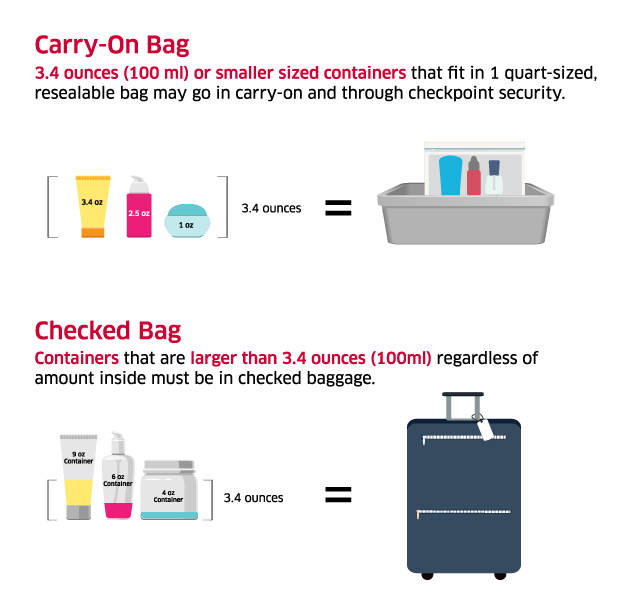
Image provided by TSA
Many stations and countries are becoming stricter when it comes to liquids, gels, and aerosols. This affects customers and non-revs, and crew members may also need to comply with these rules. Information for all destinations may found in the “Destination Information” section of the Inflight Manual inside of Comply365. If you have an NIPD layover (or turn) within a domestic sequence or fly anywhere outside of the Continental US, always confirm the rules that apply for that destination.
Image provided by TSA
There are other destinations, including Hawaii, which have agricultural rules and regulations to follow. Please verify these rules before bringing any food or agricultural products in or out of these destinations.
APFA recommends being 3-1-1 compliant, even if you are going through Known Crewmember® (KCM). Crewmembers in uniform are allowed Liquids, Aerosols and Gels (LAGs), and other exemptions applicable to uniformed flight crewmembers at TSA Pre✓™ lanes and standard passenger screening lanes.
Crewmembers not in uniform are not allowed LAGs exemptions and other exemptions applicable to uniformed flight crewmembers. Crewmembers not in uniform and randomly selected at KCM for extra screening will be required to comply with the 3-1-1 policy per TSA guidelines.
Self Defense
Active crew members of all domestic scheduled carriers are eligible for the Crew Member Self Defense Training Program. The Crew Member Self Defense Training Program provides four-hours of training to prepare active crew members of all domestic scheduled carriers for potential physical altercations both on and off the aircraft.
You can Register online for the training. To register for this no-cost training, search for the training course near you and submit the online registration form. Reporting instructions will be provided upon registration and successful verification of employment.
For more information, please email your inquiry or call (703) 487-3309.
International
Global Emergency Numbers
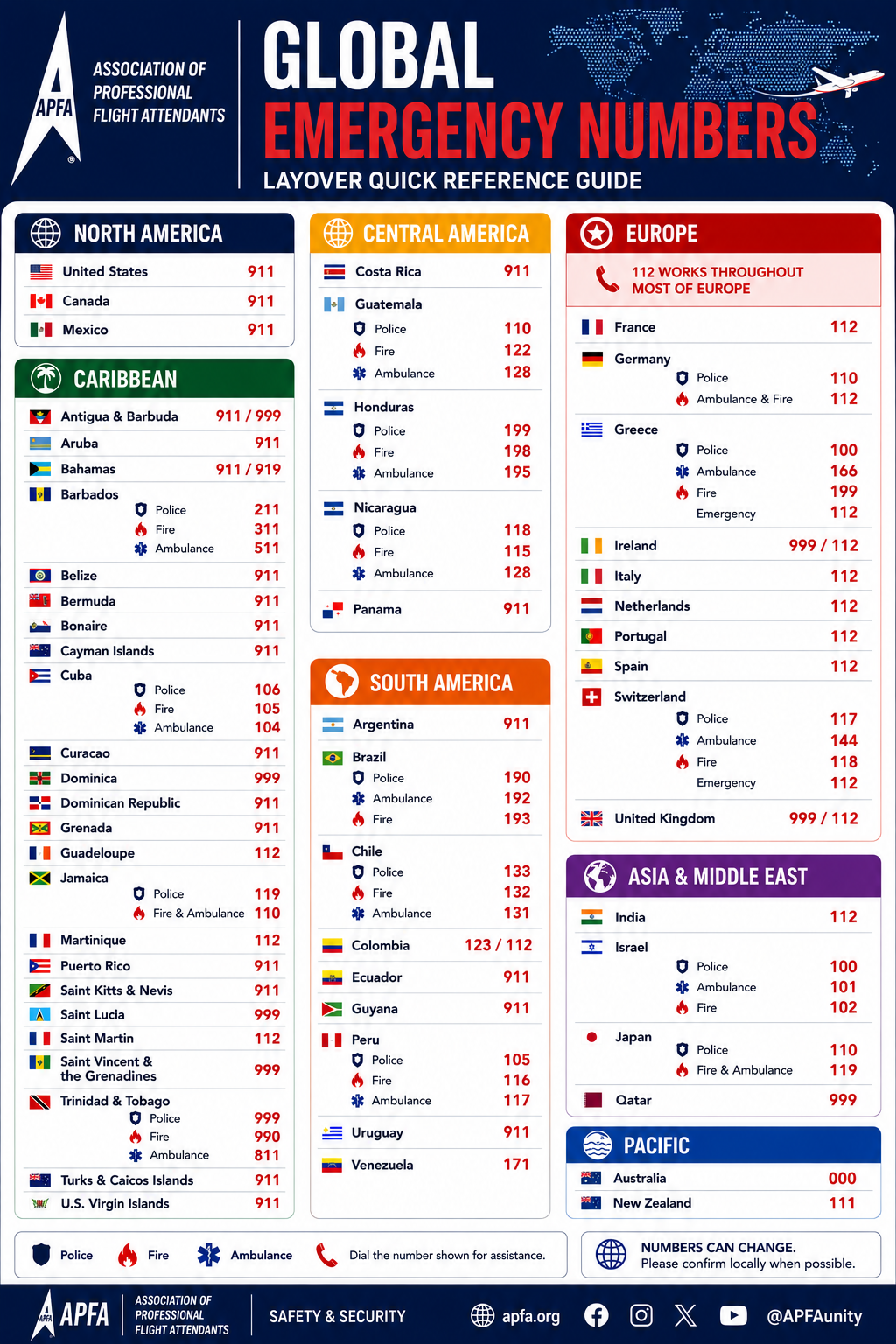
Destination Advisories
Know Before You Go: Doha
Take some time to check out the Know Before You Go guide in Comply365 > My Publications > 05 Destination Information > Doha (DOH) Know before you go to better understand the customs and culture of Doha.
London Heathrow Security Protocols
Here are the expectations when transiting LHR (per AA communications on 4/11/22):
DO
- Cooperate fully with security personnel and comply with their requests
- Pack accordingly — which includes adhering to the "3-1-1" rule for regular customers. Remember, even though you use KCM when leaving the U.S., you're subject to the 3-1-1 rule on the return flight.
- Pack neatly – which will expedite any required security searches
- Use LAG bags (20cm x 20cm /8in x 8in) which are typically available at the checkpoint in case you forgot one. Please ensure that your LAG bag can close properly with all the items inside
DON'T
- Argue or speak harshly to airport or security officials or interrupt the screeners if you’re selected for secondary screening. Any interruption of a screener while s/he is conducting their duties will further delay the process.
- Attempt to carry on "full size" toiletries or other “full size” LAGs (liquids, aerosols and gels)
- Request to use a specific security checkpoint when departing LHR. The driver will be assigned to one based on operational needs.
Remember, what’s acceptable to carry through KCM isn’t necessarily acceptable to carry through security when departing LHR.
Need a refresher on the particular rules of each city? Comply365/Destination Information is your one-stop-shop. Use your iPad (pilots) or iPhone (flight attendants) EFB or your Note 5 (flight attendants only) to access Comply365.
UK Customs: To Bring or Not to Bring
Countries Required to Spray Cargo Area
| Country | ||
|---|---|---|
| Beliz | El Salvador | Jamaica |
| Costa Rica | Guatemala | Nicaragua |
| Dominican Republic | Honduras | Panama |
Cabin Air Quality (CAQ) & Smoke Odor Fume (SOF)
What is a Fume Event?
Cabin air contamination events are when heated oils, lubricants, and fluid residue in the engine leak into the cabin air supply. Cabin air must be replenished; therefore, it consists of 50% air that comes from outside air that is pulled from engines into the air conditioning unit (Auxiliary Power Unit-APU) and 50% is recirculated air. This system of aircraft cabin air can cause contamination when air coming in from the outside through the engines is pulled into the air conditioning unit (APU) and then mixes with oil residue from an oil leak.
Due to aircraft using these bleed air filtration systems, fume events can occur on any airplane except the Boeing 787. The 787 supplies air to the aircraft by avoiding the engines and taking air from outside the aircraft by two inlets and then fed to electric cabin air compressors (CACs).
You will most likely “only” notice the odor and physical symptoms. On occasion, there are reports of people having seen a haze, therefore the only consistent detection system on our aircraft is from flight attendants, pilots, maintenance, or ground workers who either smell the odor and/or exhibit symptoms.
Cabin Air Fume Event During Flight
If any of the crew members begin to experience any physical symptoms (headache, metallic taste, coughing, irritated eye/nose/throat, dizziness and/or nausea), notify the Captain and coordinate the appropriate medical response. View the SOF Response Flowchart PDF
Not all injuries require immediate medical attention. If you do not see a doctor right away, be advised that you will need to do so within 24 hours of any lost time. In the event of a medical emergency, do not wait to speak with a nurse - go to the nearest emergency room. You must be removed from work by a doctor to become eligible for Work Comp pay benefits once the claim is accepted.
Symptoms Following an Event
If immediately following the flight, you begin to experience any physical symptoms (chest tightness, profound fatigue, muscle aches, sinus congestion and/or a persistent cough), contact the Flight Service Daily Operations desk at IOC (682-315-7070) to report the event and your illness/ injury in order to receive the necessary assistance in seeking immediate medical treatment at the nearest hospital for proper testing of a possible exposure. Recommended testing should include a blood test to determine exposure. View the Cabin Exposure Medical Information Document
If your injury requires immediate medical attention, go to the nearest emergency room.
File a Report
Each Flight Attendant should file the applicable company report. For all odor/fume events, file an IOD and a CERS Report. Flight Attendants may also consider reporting their specific safety concern regarding the odor/fume event to the Cabin ASAP program for review by AA, APFA and the FAA.
Flight Attendants may also consider reporting their specific safety concern regarding the odor/fume event to:
— Cabin ASAP reports are reviewed by the Event Review Committee (ERC) consisting of individuals from APA, APFA, the FAA, and Company.
— Please send reports of suspected odor/fume events to [email protected], [email protected], and [email protected] or file a report with APFA
To read more about the IOD process visit the APFA IOD page.
Download the SOF Event Checklist
We encourage you to file an Injury on Duty claim as soon as possible. If approved, the claim will cover lost time, medical expenses, and lost wages.
If your WC claim involved lost work time (including the use of sick leave) and you receive notice that your claim has been denied, then it is worth contacting the Industrial Commission for the state where you are based to confirm that they have a record of your denied WC claim. You can also ask the Industrial Commission if there is an ombudsman available to guide you through the appeals process.
Each State's Industrial Commissions
BOS (Massachusetts) File a Workers' Compensation Claim (mass.gov)
CLT (North Carolina) NC Industrial Commission Claimant Information
DCA (Virginia) Virginia Workers' Compensation Commission
DFW (Texas) Injured Employee FAQ (texas.gov)
LAX (California) How to File a Claim (ca.gov)
LGA (New York) File a Claim (ny.gov)
MIA (Florida) Help For Injured Workers (myfloridacfo.com)
ORD (Illinois) Resources for Employees (illinois.gov)
PHL (Pennsylvania) Workers' Compensation Claim
PHX (Arizona) Claims Division (azica.gov)
Workplace Safety
What to Do When a Crewmember Doesn’t Show Up for Pickup
- Arrival to Layover – FA #1/Purser or FA Designee take down all crew member hotel room numbers and or cell phone numbers for emergency contact only.
- Pickup – If FA(s) are not present in time for pickup/hotel departure, have the hotel front desk call their hotel room(s), and or the provided emergency contact phone number(s).
- If No Answer – Call both AA IOC Daily Ops at (682) 315-7070 as well as the APFA Safety and Security Department at 817-357-8786, or you may email at [email protected]. * Please note we recommend that you contact both AA IOC Daily Operations as well as APFA Safety and Security when alerting of a FA no show. When contacting; please provide, Date, Time, departing flight information, affected crew member(s) information, as well as the layover hotel so that we may follow up with hotel security.
- Request Wellness Check from Hotel Security – After you have called and alerted both AA IOC Daily Ops and APFA Safety and Security, please ask that the hotel send up their security staff to conduct a wellness check on the affected crew member(s).
- Call Crew Tracking – After contacting AA IOC Daily Ops and APFA Safety and Security and after advising the hotel to complete the wellness check. Please, contact Crew Tracking to alert of the missing crew member so that operations can take the next steps appropriately with staffing your departing flight.
Safety Documents & Resources
APFA Headquarters
1004 West Euless Boulevard
Euless, Texas 76040
M-F: 9:00AM - 5:00PM (CT)
Phone: (817) 540-0108
Contract & Scheduling Desk
M-Th: 9:00AM - 5:00PM (CT)
Phone: (817) 540-0108
Live Chat Messaging
Fridays: 9:00AM - 5:00PM (CT)
Currently, no scheduled events...